
Your net worth tells you how much wealth you have built; your net worth velocity tells you how quickly it is changing. Calculate your trailing 12-month rate, separate progress you control from market-driven gains, and you can estimate whether your next $100,000 is likely to take two years, five years, or longer.
This is a planning tool, not a prediction. Its value is replacing a vague goal such as “build more wealth” with a measurable rate, a realistic target range, and a short list of financial decisions you can control.
What does net worth velocity measure?
Net worth is the value of your assets minus your liabilities. Assets may include cash, investments, retirement accounts, real estate, and other property with a defensible resale value. Liabilities include credit cards, student loans, auto loans, mortgages, and other debts.
If you own $310,000 of assets and owe $125,000, your net worth is $185,000. Net worth velocity adds time to the calculation by comparing that balance with an earlier measurement.
Suppose your net worth rises from $185,000 to $232,000 in 12 months. Your annual net worth velocity is $47,000, or approximately $3,917 per month. A straight-line estimate suggests that another $100,000 would take about 26 months if the same pace continued.
The Federal Reserve’s Survey of Consumer Finances measures household assets, debts, and net worth across the United States. National figures can provide context, but they cannot determine what your personal rate “should” be. Age, income, household size, housing costs, health, caregiving responsibilities, and inherited resources all affect the result. Use the Federal Reserve Survey of Consumer Finances as a reference—not as a scoreboard.
A balance alone also says little about direction. Someone with a $500,000 net worth that has been flat for three years may need a different plan from someone with $80,000 who added $30,000 last year. Establish a consistent baseline by following a repeatable process for tracking your net worth.
Action: Record today’s date, total assets, total liabilities, and net worth. Keep the supporting account balances so you can reproduce the calculation later.
How do you calculate your current net worth velocity?

A useful calculation requires consistent account coverage, valuation rules, and dates. Changing the method halfway through a period can make your velocity appear to improve even when your finances did not.
Choose a repeatable net worth definition
Include cash, investment accounts, retirement balances, and outstanding debts. Decide whether your calculation will also include your home, vehicles, business equity, pensions, or valuable personal property.
There is no single correct definition for every household. A homeowner may reasonably include home equity while maintaining a separate “investable net worth” figure that excludes the home. A business owner may include a conservative business valuation, but that estimate may be illiquid, volatile, and difficult to verify.
- Total net worth: reasonably valued property and financial assets minus all debts.
- Financial net worth: cash and investment assets minus financial liabilities.
- Liquid net worth: assets available relatively quickly, minus debts that must still be paid.
Pick one primary definition and preserve it. If an asset is difficult to value, exclude it or document a conservative valuation method. For a home, for example, avoid treating an optimistic online estimate as guaranteed sale proceeds.
Match the beginning and ending dates
Use balances from comparable dates and include the same accounts at both endpoints. If you open a new account, include both the new account and the source account so an internal transfer does not look like new wealth. If a previously omitted asset is added, restate the earlier balance when possible or label the change as a methodology adjustment.
Use a period long enough to reduce noise
Monthly tracking can reveal trends, but one month is often misleading. Investment prices move, bonuses arrive unevenly, annual bills cluster, and major purchases create temporary swings. A trailing 12-month period usually provides a clearer headline rate, supported by monthly or quarterly check-ins.
A $12,000 market gain in one month does not establish a sustainable $144,000 annual velocity. Similarly, paying an annual insurance premium may produce a weak month without changing the long-term direction.
Separate total velocity from controllable progress
Total velocity captures every change in net worth. Controllable progress focuses on retained income directed to assets and debt principal, less withdrawals or new borrowing. Separating the two prevents a strong market year from disguising weak cash flow—or a market decline from obscuring disciplined saving.
Estimated controllable progress equals new savings and investment contributions from current income, plus debt principal paid from current income, minus withdrawals and new debt used for consumption.
Be careful with transfers. Moving $10,000 from checking to a brokerage account does not add $10,000 to net worth. Likewise, using $10,000 of existing cash to repay $10,000 of debt generally reduces assets and liabilities by the same amount, producing no immediate net worth increase. Debt principal contributes to period progress when it is paid from income that otherwise would have been spent.
The estimate does not need to be exact to the dollar, but it must be consistent enough to guide decisions. A spreadsheet, account aggregator, or quarterly financial statement can work. Third-party tools involve privacy, security, and possible subscription costs, so review their policies before connecting accounts.
Action: Calculate your trailing 12-month total velocity and estimated controllable progress. Keep both figures rather than choosing the more flattering result.
How long will the next $100K take?

Start with a straight-line estimate: divide the target by annual net worth velocity. Then repeat the calculation using controllable progress to create a more conservative planning range.
Consider Maya, whose net worth increased from $185,000 to $232,000 over the past year. Her $47,000 increase can be explained as follows:
| Source of growth | Annual amount | Level of control |
|---|---|---|
| Retirement contributions funded from current income | $18,000 | Mostly controllable |
| New cash and brokerage savings from current income | $9,000 | Mostly controllable |
| Mortgage principal paid from current income | $6,000 | Partly controllable |
| Investment and property appreciation | $14,000 | Not controllable |
| Total net worth change | $47,000 |
This estimate assumes Maya’s recent total velocity continues. It is useful for orientation, but it is not a promise. Market returns, property values, employment, expenses, taxes, and interest costs can change.
Her estimated controllable progress is $33,000: $18,000 of retirement contributions, $9,000 of new cash and investment savings, and $6,000 of mortgage principal paid from current income. Excluding appreciation, the same target would take approximately three years.
A reasonable planning range is therefore 26 to 36 months. The faster end assumes recent appreciation persists; the slower end relies mainly on behavior Maya has demonstrated she can sustain.
Compounding may accelerate growth because investment returns can generate additional returns, but positive performance is never guaranteed. The Investor.gov compound interest calculator can illustrate different contribution, time, and return assumptions. Test a low, middle, and high scenario rather than treating one return percentage as a forecast. If market volatility makes the process feel speculative, review the distinction between long-term investing and gambling.
Action: Divide your target by both total velocity and controllable progress. Write the answers as a range and revisit it quarterly.
How can you increase net worth velocity without taking reckless risks?

The durable ways to improve controllable progress are limited: increase income retained after taxes and spending, direct more cash flow to assets, reduce interest costs, or prevent avoidable withdrawals. Chasing unusually high returns is not a dependable substitute.
| Possible move | Potential annual effect | Main tradeoff |
|---|---|---|
| Invest an additional $500 per month | $6,000 in added contributions | Less current spending flexibility |
| Direct a $4,000 gross raise to wealth building | Less than $4,000 after applicable taxes and deductions | Depends on sustainable earnings growth |
| Pay $300 more toward debt principal each month from income | $3,600 more principal repaid annually | Less liquid cash; verify prepayment terms |
| Reduce a recurring cost by $200 per month | $2,400 if the entire saving is retained | May require a service or lifestyle change |
Prioritize high-impact recurring decisions: housing, transportation, expensive debt, earnings, taxes, and automated contributions. This is the practical idea behind the 80/20 approach to personal finance. Automating a chosen amount shortly after payday can also make the improvement repeatable; see a practical approach to automating finances.
Compare changes by their annual effect. If your controllable progress is currently $30,000, adding $250 per month increases it by as much as $3,000 per year, or 10%, assuming the money is not offset by withdrawals elsewhere. Your estimated $100,000 timeline falls from 40 months to about 36 months:
Do not empty every cash reserve to improve the number. An emergency expense paid from cash may temporarily reduce velocity, but relying on expensive credit can produce a larger setback. The CFPB explains steps for preparing credit and comparing terms before a major purchase in its consumer guidance for financing a major purchase. Also consider the risks of using credit instead of emergency savings.
Tax treatment, retirement-account rules, debt contracts, and investment suitability vary by jurisdiction and personal circumstances. Consult an appropriately credentialed tax, financial, or legal professional before making a consequential change involving taxes, concentrated assets, retirement withdrawals, or business valuations.
Action: Choose one recurring change that could add at least 5% to your controllable progress without weakening emergency reserves or essential protection.
Which mistakes make net worth velocity misleading?

Velocity is useful only when you understand what moved it. Watch for these common failure modes:
- Annualizing a short period: A strong month may contain a bonus, tax refund, or market rally that will not repeat.
- Double-counting transfers: Moving money between accounts changes its location, not your net worth.
- Counting investment gains as guaranteed: Appreciation can reverse, particularly over short periods.
- Using optimistic property values: Estimated value is not the same as net sale proceeds after debt and transaction costs.
- Ignoring withdrawals and new borrowing: Contributions may not represent progress if spending or debt offsets them elsewhere.
- Changing definitions: Adding a home, pension, or business valuation midway through the year can create artificial growth.
- Prioritizing velocity over life: Parental leave, education, disability, caregiving, or relocation can intentionally slow wealth accumulation.
Tracking can support informed decisions, but one financial metric is not a complete measure of well-being. This analysis of the benefits and limitations of tracking net worth offers additional perspective.
A negative year does not automatically mean your plan failed. If investments declined while you continued contributing and reducing debt from income, controllable progress may remain positive. Conversely, rapid growth caused by one concentrated asset can raise net worth while also increasing risk.
Action: Add a one-sentence explanation beside every major quarterly change. Label it as new saving, debt reduction, withdrawal, borrowing, valuation adjustment, or market movement.
How do you choose a better target than $100,000?
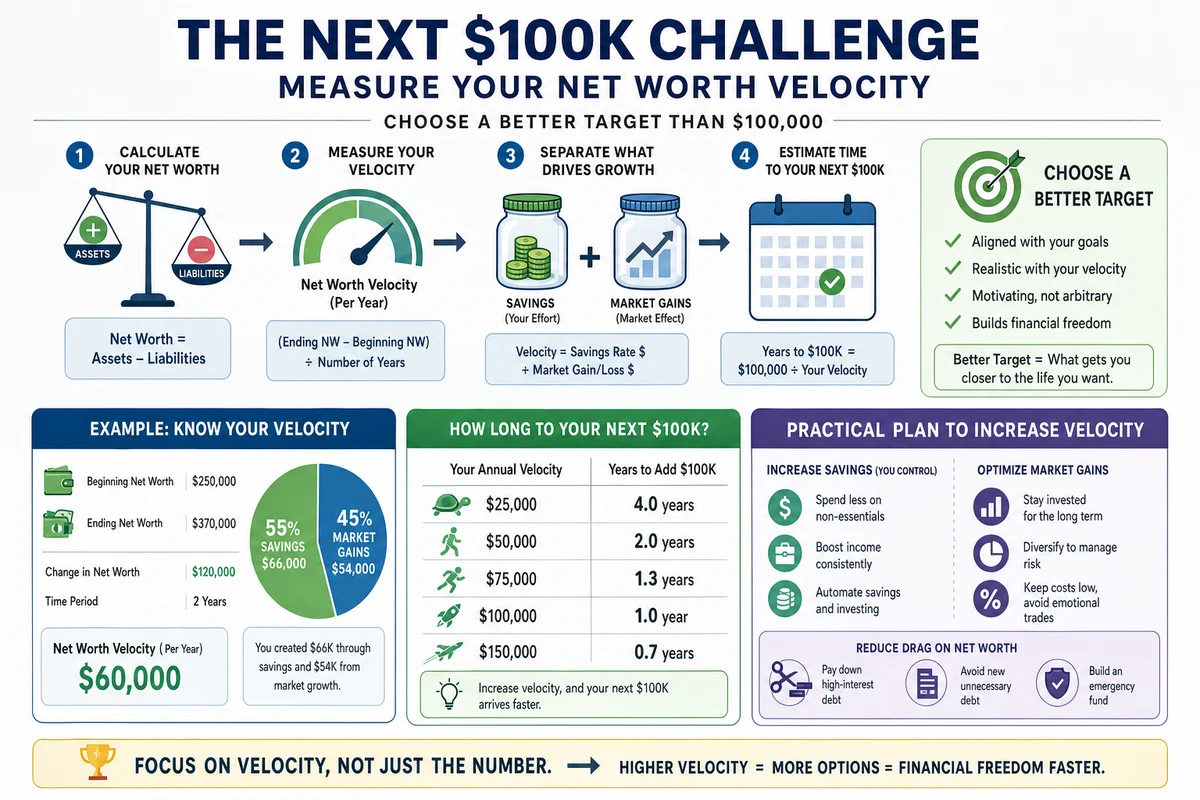
The next $100,000 is easy to understand and large enough to require a plan, but it is not universally appropriate. If it feels too distant, choose a smaller milestone that can influence decisions now. If it is too small relative to your finances, use a larger amount or a percentage-based target.
- Round milestone: Add $10,000, $25,000, $50,000, $100,000, or $250,000 to net worth.
- Percentage target: Increase net worth by 10% or 20% so the target scales with your current position.
- Liability target: Eliminate a defined debt balance or reach a specific mortgage principal.
- Resilience target: Build a chosen amount of essential expenses or restore a depleted cash reserve.
- Freedom target: Build a career-change fund or reach a defined investable asset balance.
As a rule of thumb—not a financial standard—consider a target equal to one to three years of your current controllable progress. That range is often close enough to affect current choices without depending heavily on uncertain long-term forecasts.
Someone with controllable progress of $12,000 per year might choose a $25,000 challenge:
Example: $25,000 ÷ $12,000 = 2.08 years, or about 25 months.
If that person raises controllable progress to $15,000, the estimate falls to approximately 20 months. The purpose is not merely to choose an easier number. It is to select a milestone close enough to guide current tradeoffs while still representing meaningful progress. When comparing those tradeoffs, consider what an additional dollar is worth to you now.
Action: Choose a target, define what counts toward it, record your starting value, and set a review date. A target without a consistent definition cannot be measured reliably.
What should you do next?
Calculate the last 12 months
Use matching account coverage and valuation rules to find your total net worth change. Note any large one-time event, such as an inheritance, home purchase, business sale, or methodology change.
Estimate the portion you controlled
Add new saving, investment contributions, and debt principal paid from current income. Subtract withdrawals and consumer borrowing. Keep transfers between existing assets out of the total.
Choose a target and calculate a range
Divide the target by total velocity and controllable progress. Write the result in a specific form: “My next target is $50,000. Based on the last 12 months, it may take approximately 28 to 34 months.”
Improve one recurring input
Select one change in income, spending, debt cost, or automated saving. Calculate its annual effect before committing, and avoid changes that undermine liquidity, insurance, or other essential protections.
Review quarterly and recalculate annually
Quarterly reviews are frequent enough to catch errors and explain major changes without reacting to every market move. Recalculate the headline 12-month velocity annually—or after a major life event—and revise the target when your circumstances change.