
Elon Musk’s first-principles thinking means reducing a business problem to facts that can be tested, then building a solution from those facts instead of automatically copying industry convention. Tesla and SpaceX show the potential payoff: questioning expensive assumptions may reveal a more efficient product architecture, manufacturing process, or business model.
The method is not permission to ignore experience, regulation, or risk. It is a disciplined way to separate physical and economic constraints from statements such as “this is how the industry works.” This guide explains how to apply first-principles thinking, calculate whether an unconventional idea is financially viable, and stop before an ambitious experiment becomes an expensive obsession.
What does Elon Musk’s first-principles thinking mean in business?
A first principle is a basic fact that remains true after assumptions, analogies, and preferences have been removed. In physics, those facts might include mass, energy, temperature, and material properties. In business, they include customer needs, input costs, production capacity, available cash, legal requirements, and the time required to deliver a result.
Reasoning by analogy starts with an existing pattern: competitors charge this price, suppliers use this process, or companies in this market need a large sales team. First-principles thinking asks what must actually be true. Does the customer require the traditional process, or only the outcome it produces? Does an outside supplier have an unavoidable cost advantage, or has outsourcing merely become customary?
Reasoning by analogy
“Competitors manufacture this component overseas, so we should do the same.”
The starting point is an existing industry solution.
Reasoning from first principles
“The component must meet these dimensions, tolerances, volumes, and safety requirements. What is the lowest-cost reliable way to achieve them?”
The starting point is the required outcome and its constraints.
Analogies are not inherently bad. They compress accumulated experience and help businesses avoid familiar mistakes. The danger appears when an analogy is mistaken for a law. A practical way to choose where deeper analysis is worthwhile is to identify the small number of costs or constraints driving most of the result, as described in the 80/20 approach to financial decisions.
Action: Take one costly rule in your business and rewrite it as a question. Replace “we must use this process” with “what measurable result must this process produce?”
How did Tesla challenge basic automotive assumptions?

Tesla’s strategy offers several examples of challenging the conventional structure of an industry. Its original master plan did not begin by trying to manufacture the cheapest possible electric car immediately. It proposed selling a higher-priced sports car, using the proceeds and experience to develop more affordable vehicles, and continuing down the price curve. Tesla published that sequence in its 2006 original Tesla master plan.
The underlying constraint was capital. Developing vehicles and factories requires substantial investment, while a young manufacturer lacks the scale, supply relationships, and operating history of established automakers. Starting with a premium, lower-volume product offered more revenue per vehicle and created an opportunity to test electric-vehicle demand before attempting mass-market scale.
This does not prove that every part of the sequence was optimal. It demonstrates a useful decision pattern: identify the limiting resource, design the first product around that constraint, and use the resulting knowledge or cash flow to attempt the next stage. Entrepreneurs can apply the same pattern by starting with a narrow paid service before investing in software, machinery, inventory, or additional locations.
Tesla also questioned whether an electric vehicle had to be a conventional car with a battery substituted for an engine. Its approach increasingly treated the battery pack, software, electric motors, thermal system, and manufacturing process as parts of one architecture. That systems-level view matters because optimizing one component can increase total cost elsewhere. A cheaper battery cell, for example, is not truly cheaper if it requires more packaging, cooling, assembly time, or warranty expense.
Manufacturing decisions reflect the same logic. Reducing the number of parts or combining several body components into larger castings can remove fasteners, handling steps, and factory floor space. However, larger castings can also concentrate risk: a defect may affect a more valuable part, repairs may become harder, and specialized equipment needs enough production volume to justify its cost.
Action: Map one product from raw inputs to customer delivery. Mark every handoff, component, approval, and delay that exists because of legacy design rather than a current customer, quality, or safety requirement.
How did SpaceX question the economics of rocket launches?

Traditional launch economics were shaped by rockets that were largely discarded after one use. SpaceX challenged the assumption that a launch vehicle’s major hardware must always be expendable. The fundamental customer requirement is to place a payload into its intended orbit safely—not to destroy every major piece of hardware while doing it.
That reframing made reusability both an engineering problem and an economic one. A recoverable booster needs additional hardware, fuel reserves, guidance capability, inspection procedures, and refurbishment work. Those requirements can reduce payload capacity or add operational complexity. Reuse creates financial value only when recovery and refurbishment cost less than the avoided cost of building another stage, while reliability remains acceptable.
SpaceX describes Falcon 9 as a reusable, two-stage rocket and identifies the first stage as containing nine engines and most of the vehicle’s structures and systems. Its official Falcon 9 vehicle overview explains the architecture and recovery process.
SpaceX also participated in milestone-based development relationships rather than relying only on conventional cost-plus procurement. NASA’s Commercial Orbital Transportation Services program used funded agreements tied to technical and financial milestones to encourage private cargo transportation capabilities. NASA documents the program in its Commercial Orbital Transportation Services history.
The broader business insight is that an expensive asset may become more productive when it can perform more revenue-generating cycles over its useful life. That principle can apply to industrial tooling, reusable packaging, software platforms, rental equipment, training materials, or intellectual property.
Utilization still matters. A reusable asset sitting idle may be less economical than a simpler disposable or outsourced alternative. Before buying equipment or developing a reusable system, estimate how many paid cycles it will realistically complete—not how many it could complete under perfect conditions.
Action: Identify your most expensive single-use asset or repeated setup cost. Estimate whether reuse, standardization, or modular design could spread that cost across more customer transactions.
How can you apply first-principles thinking step by step?

A useful process must prevent “first principles” from becoming a sophisticated label for intuition. Use the following three stages and document the evidence behind each important statement.
Separate facts from assumptions
Write every claim about the problem in a table and classify it as a fact, assumption, preference, or unknown. A fact should be observable and supported by current evidence. “The customer requires delivery within 48 hours” is a fact only if contracts, purchasing behavior, or direct customer research support it. Otherwise, it is an assumption.
- Facts: Current volume is 2,000 units a month; the part must tolerate a specified load; available cash is $300,000.
- Assumptions: Customers will reject redesigned packaging; production must remain outsourced; demand will grow 20%.
- Preferences: Management wants a premium appearance, specific vendor, or particular technology.
- Unknowns: Defect rate at higher volume, willingness to pay, approval time, or maintenance cost.
Assign an owner and verification method to each important assumption. Interviews can test customer beliefs, supplier quotes can test cost estimates, and prototypes can test technical performance. Explicitly record what result would disprove the preferred idea. Reading about other business models can broaden the options considered, but the ideas still need to be tested against your circumstances; see the tradeoffs between incremental savings and a low-overhead strategy.
Rebuild the problem from basic constraints
Describe the minimum successful outcome without naming the current solution. Instead of “we need a call center,” write “customers need accurate answers within five minutes, with sensitive cases escalated to a qualified employee.” That framing creates room for better documentation, workflow automation, chat, or a smaller specialist team.
List non-negotiable constraints: safety, law, required quality, capacity, deadline, available capital, and acceptable failure rate. Then list variables that can change: material, supplier, location, interface, staffing model, batch size, and sales channel.
The same outcome-first discipline applies to financial systems. For example, the objective is not merely to own budgeting software; it is to identify unusual spending quickly enough to respond. Our guide to automating expense monitoring around specific alerts shows how a clear outcome can guide the choice of tools and thresholds.
Test technical and economic viability separately
A solution can work technically and still destroy cash. First prove that it can meet the required performance under realistic conditions. Then model the complete economics, including engineering labor, equipment, financing, downtime, scrap, compliance, training, maintenance, and the cost of failure.
Run a small, reversible test before committing to a full rollout. A useful pilot has a budget cap, a deadline, success thresholds, and a shutdown rule. It should test the riskiest assumption—not merely demonstrate the easiest feature. If the risk is customer demand, a polished technical prototype alone does not answer the question. The same distinction between evidence-based risk and speculation helps explain why investing is not the same as gambling.
First-principles problem worksheet
- Define the customer outcome without describing the existing solution
- List verified facts and attach evidence
- Label assumptions, preferences, and unknowns separately
- Record physical, legal, financial, and time constraints
- Generate at least three architectures, including the status quo
- Set technical, economic, and customer success thresholds
- Run the cheapest test capable of disproving the preferred idea
Action: Schedule a 60-minute review for one active project. Do not brainstorm solutions until the team has agreed on the facts, unknowns, and non-negotiable constraints.
How do you calculate whether an unconventional solution is viable?

Compare total relevant cost over the same production volume and time period. Separate fixed costs, which do not change directly with each unit, from variable costs, which rise as volume increases.
In this formula, Q is break-even volume, F is fixed cost, and V is variable cost per unit. The formula applies when the new option has higher fixed cost but lower variable cost. If the denominator is zero or negative, the unconventional option does not gain an operating-cost advantage as volume increases.
Consider a fictional manufacturer choosing between buying an enclosure and producing a redesigned version internally. The supplier charges $120 per unit and requires $40,000 of tooling. Internal production requires $350,000 of equipment, $90,000 of engineering, and $30,000 of first-year maintenance, for total fixed costs of $470,000. Estimated internal variable cost is $68 per unit, including material, labor, energy, and expected scrap. These illustrative cost categories follow the structure in the SBA’s guidance on calculating startup and operating costs.
The break-even volume is ($470,000 − $40,000) ÷ ($120 − $68), or approximately 8,269 units. At 10,000 units, the supplier option costs $1.24 million: $40,000 of tooling plus $1.2 million in unit costs. Internal production costs $1.15 million: $470,000 of fixed costs plus $680,000 in unit costs. The estimated first-year advantage is $90,000. This calculation applies the one-time and recurring cost categories described in the SBA’s startup cost guidance.
That result is not yet a decision. If demand reaches only 7,000 units, outsourcing costs $880,000 while internal production costs $946,000. The company would spend $66,000 more—and would still own equipment that might have limited resale value. A real analysis should verify each input using the SBA’s framework for estimating business expenses.
Add scenarios for lower volume, delayed launch, higher scrap, and equipment downtime. Also consider opportunity cost: investing $440,000 in equipment and engineering may prevent the company from funding a more valuable product, hiring sales staff, or preserving a cash buffer. The SBA’s guidance on calculating startup and operating costs offers a practical structure for capturing one-time and recurring expenses. For owners comparing present spending with future capacity, the same tradeoff appears in the financial value of delayed gratification.
If debt would fund the equipment, compare financing charges, repayment timing, collateral requirements, and downside exposure—not just the monthly payment. The same principles used to evaluate whether to finance or save for a major purchase apply to business capital decisions.
Action: Calculate break-even volume, then rerun the model at 70%, 100%, and 130% of expected demand. Reject or redesign a plan that works only under one optimistic forecast.
Where can first-principles thinking fail?
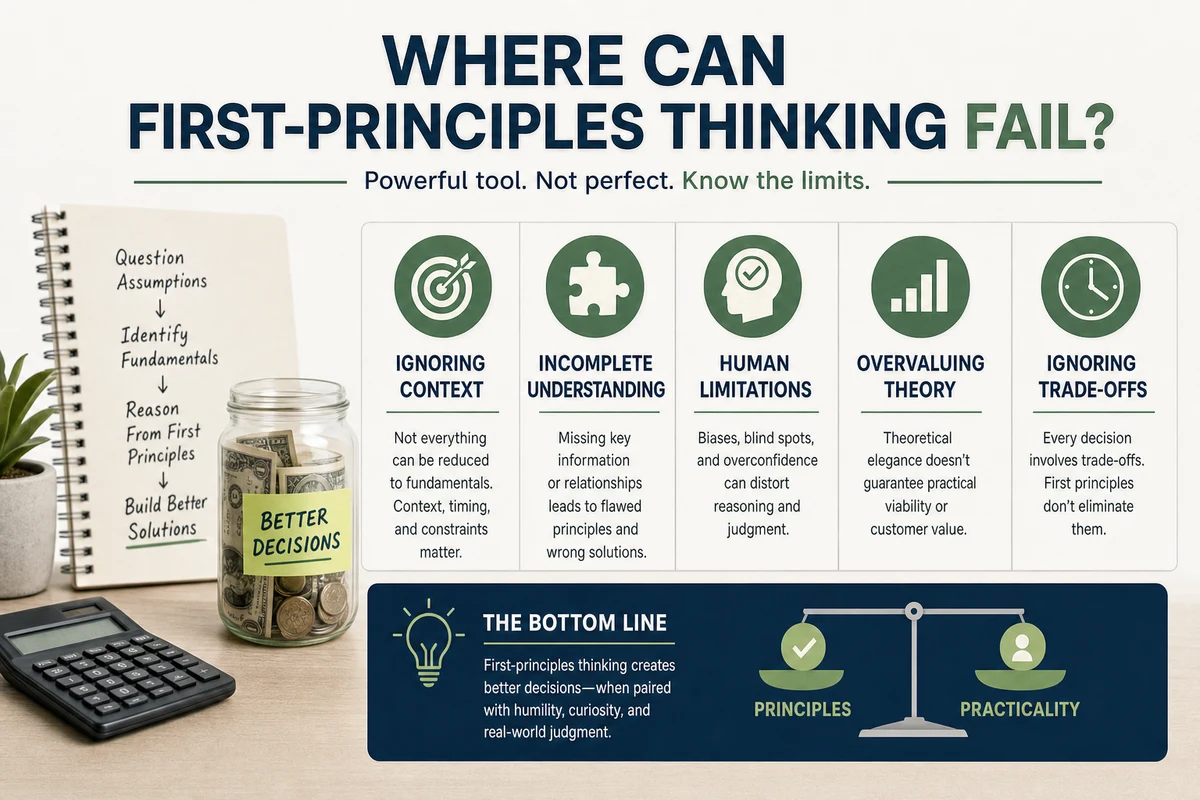
The method can fail when leaders treat uncertain estimates as facts, underestimate implementation costs, or dismiss accumulated industry knowledge. A regulation may look inefficient while protecting against a rare but severe failure. A supplier’s margin may appear excessive until tooling, quality assurance, inventory, and warranty risk are counted.
Another failure mode is excessive vertical integration, meaning that a company brings too many suppliers or production stages under its direct control. Owning more of the process can improve coordination and preserve specialized knowledge, but it also increases fixed costs and concentration risk. Outsourcing can be rational when a supplier has superior scale, demand is volatile, or the activity does not create a meaningful competitive advantage.
Build or redesign internally
Consider when: the process creates differentiation, demand is durable, knowledge compounds, and volume exceeds break-even with a margin of safety.
Main risks: high fixed costs, execution delays, technical failure, and management distraction.
Buy or follow the standard
Consider when: suppliers have scale advantages, demand is uncertain, standards matter, or speed is more valuable than customization.
Main risks: supplier dependence, limited differentiation, price increases, and slower iteration.
Watch for founder authority becoming a substitute for evidence. An unconventional idea should face stronger testing, not weaker testing. Define stop-loss rules before money is committed: maximum pilot spend, latest acceptable launch date, minimum customer adoption, and maximum defect rate.
Protect operating liquidity as well. A project that eventually reduces unit costs can still fail if equipment deposits, engineering expenses, or launch delays consume the cash needed for payroll and routine obligations. The principles in building a cash reserve before relying on credit can help frame why accessible cash matters, although a business should size its reserve around its own expenses, revenue volatility, and financing access.
Action: Ask a qualified skeptic to review the plan and identify the three assumptions most likely to make its projected savings disappear.
What should you test first?
Start with a decision that is expensive enough to matter but small enough to reverse. Good candidates include a recurring supplier cost, an approval bottleneck, a product feature customers rarely use, or a manual process that delays delivery.
Prioritize the work in this order:
- Verify demand. Confirm the customer outcome before redesigning the system that delivers it.
- Expose assumptions. Label every unsupported claim and identify the one that could invalidate the project.
- Model the status quo. Include all current costs so the comparison is fair.
- Design a falsifiable pilot. Set a budget, deadline, threshold, and shutdown rule.
- Protect liquidity. Keep enough cash available for normal obligations and a failed test.
- Scale only after evidence. Commit major capital after technical performance and unit economics survive realistic scenarios.
First-principles thinking is most useful when it improves the quality of a decision, not merely the originality of an idea. Your highest-priority next step is to choose one costly assumption this week, write down the evidence that would prove or disprove it, and run the smallest credible test before making a larger financial commitment.