
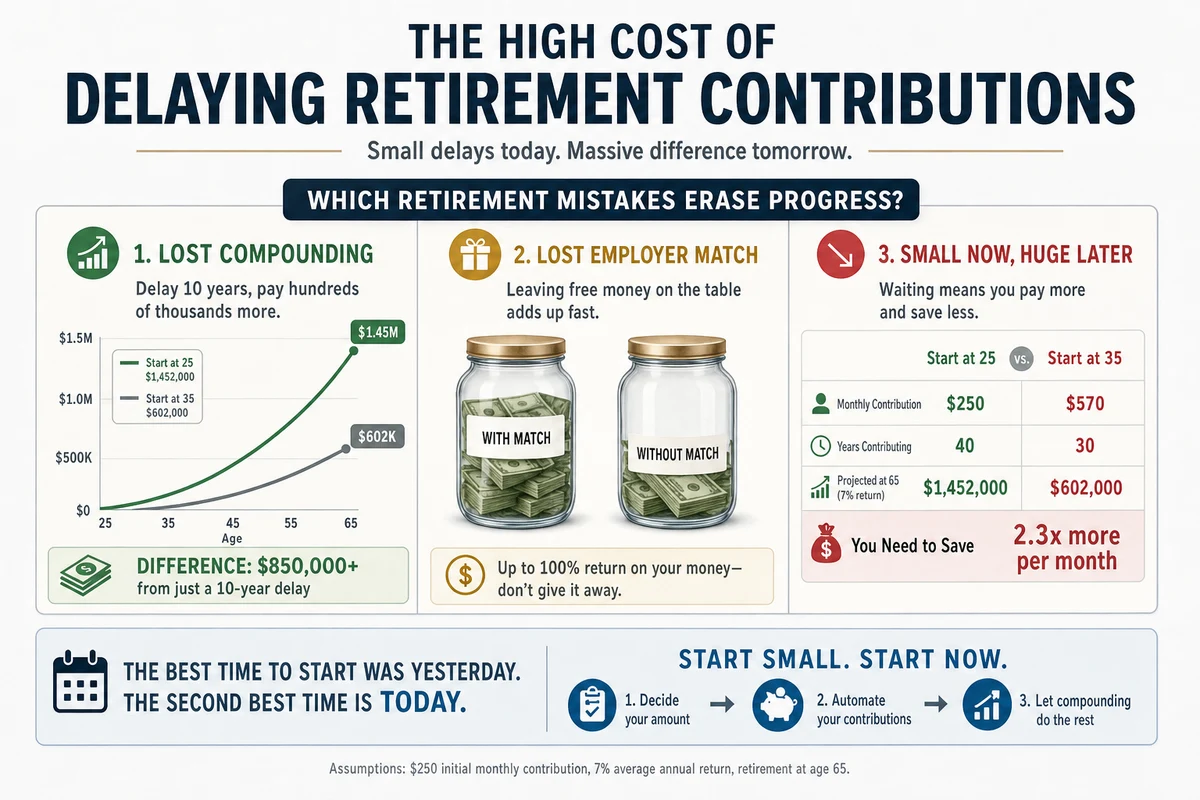
Delaying retirement contributions costs more than the deposits you skip. You also lose years of potential compound growth, which can force you to save substantially more each month later to target the same retirement balance.
For example, investing $500 at the end of every month for 40 years could grow to approximately $996,000 under a hypothetical 6% annual return compounded monthly. Waiting 10 years and investing the same amount for 30 years produces an estimate of about $502,000. The delayed saver contributes only $60,000 less but finishes nearly $493,500 behind in this illustration.
Those balances are planning estimates, not promises. This guide shows the assumptions behind the math, how an employer match changes the decision, what to prioritize before increasing retirement savings, and how to create a practical catch-up plan if you have already waited.
How much can delaying retirement contributions cost?

Compound growth occurs when investment gains remain invested and may generate additional gains. A contribution made at age 25 has 40 years to participate in the market before age 65. A contribution made at age 35 has only 30 years—and misses the potential growth that could have accumulated during the first decade.
In this formula, P is the monthly contribution, r is the assumed monthly return, and n is the number of monthly deposits. It assumes each contribution arrives at the end of the month and returns compound monthly. Actual investments do not earn a smooth return, so this formula is useful for comparing scenarios—not predicting an account’s exact future value.
Consider two hypothetical workers. Alex makes 480 monthly contributions of 500 dollars, beginning at age 25 and ending just before age 65. Jordan makes 360 monthly contributions beginning at age 35. The calculation assumes a 6 percent nominal annual return divided into monthly periods, with no taxes, fees, withdrawals, contribution increases, or employer match.
| Measure | Start at 25 | Start at 35 |
|---|---|---|
| Monthly contributions | 480 | 360 |
| Monthly amount | $500 | $500 |
| Total contributed | $240,000 | $180,000 |
| Estimated balance at 65 | $995,745 | $502,258 |
| Estimated growth above contributions | $755,745 | $322,258 |
The estimated balance gap is $493,487. Only $60,000 of that gap comes from Alex’s additional deposits; the rest reflects potential growth under the stated assumptions. To target Alex’s estimated balance while starting at 35, Jordan would need to contribute approximately $991 per month for 30 years—almost twice as much as Alex.
This does not mean every person should contribute $500 immediately. It means time lowers the monthly burden of pursuing a given target. The same principle is explained in the guide to using compound interest to make money work over time.
Action: If you can contribute without missing essential bills, begin with an affordable automatic amount now. Waiting for enough room to make a “perfect” contribution can turn a temporary delay into several lost years.
How do investment returns and inflation change the result?

A retirement projection is only as useful as its assumptions. A large future balance can look certain when the return, fees, inflation, and contribution timing are hidden. Testing several scenarios gives you a range rather than a false promise.
The following table applies the same 500 dollars end-of-month contribution to three constant-return illustrations. The balances are nominal, meaning they have not been adjusted for future inflation.
| Assumed annual return | 40 years | 30 years | Estimated gap |
|---|---|---|---|
| 4% | $590,196 | $347,025 | $243,171 |
| 6% | $995,745 | $502,258 | $493,487 |
| 8% | $1,745,503 | $745,180 | $1,000,323 |
Higher assumed returns magnify the modeled advantage of starting early, but they also create more room for the result to disappoint. Real returns vary, investment expenses reduce account growth, and a diversified portfolio can lose value. The sequence of returns becomes especially important when a retiree begins making withdrawals.
Inflation affects purchasing power too. If an investment earned 6% while inflation averaged 2.5%,
the approximate inflation-adjusted return would be 3.4%: (1.06 ÷ 1.025) − 1. Neither assumption is guaranteed. You can compare contribution
periods, returns, and variability with the Investor.gov compound interest calculator.
Action: Run conservative, moderate, and optimistic scenarios. Base your initial plan on the conservative or moderate result, and treat the optimistic balance as a possibility rather than an entitlement.
How much does an employer retirement match change the decision?

An employer match is a contribution a company makes when an employee contributes to an eligible workplace plan. For example, a plan might contribute 50 cents for each employee dollar, up to 6 percent of pay. Formulas differ, so use the current summary plan description rather than a coworker’s recollection.
Suppose an employee earns 60,000 dollars and contributes 6 percent, or 3,600 dollars per year. Under a hypothetical match equal to 50 percent of employee contributions up to 6 percent of pay, the employer contributes 1,800 dollars. The employee’s 3,600 dollars outflow therefore places 5,400 dollars in the account before investment gains or losses.
The 1,800 dollars employer deposit equals 50 percent of the employee’s contribution, but it is not a guaranteed 50 percent annual investment return. The account can decline after the money is invested, and employer contributions may be subject to vesting.
Vesting determines when employer-funded money becomes permanently yours. Employee salary deferrals are generally vested, while employer contributions may vest immediately, gradually, or after a specified service period. Leaving before a vesting milestone can result in forfeiting unvested employer money. The U.S. Department of Labor retirement planning guidance identifies workplace-plan information employees should review.
Also ask how often the match is calculated. Some plans match each pay period. If you reach an annual contribution limit early and the plan does not provide a year-end “true-up,” paychecks with no employee contribution may receive no match. A true-up is an additional employer deposit that reconciles eligible annual contributions with the plan’s matching formula.
Action: Obtain your plan documents and record four details: the matching formula, the percentage required for the full match, the vesting schedule, and whether the plan performs a true-up.
What should you prioritize before increasing retirement savings?

“Max out retirement accounts first” is too rigid for many households. Someone facing eviction, an urgent medical expense, or unaffordable credit-card debt may need accessible cash more than additional locked-up retirement money. A useful order of operations protects immediate needs while preserving valuable employer benefits when possible.
Protect essential cash flow
Pay for housing, utilities, food, essential transportation, insurance, required debt payments, and necessary healthcare first. Then establish a starter cash buffer so a routine repair does not immediately create new high-interest debt.
The eventual emergency-fund amount depends on job stability, insurance deductibles, household income sources, health needs, and available support. The discussion of why credit is not a complete substitute for emergency savings can help you assess that tradeoff.
Capture the full affordable employer match
Once essential cash flow is stable, contribute enough to receive the full match if your budget allows. Forgoing a match can mean losing both the employer deposit and decades of potential growth. However, do not skip rent, food, medication, insurance, or required minimum debt payments to capture it.
Compare the best use of the next dollar
After the match, compare additional workplace-plan contributions, high-interest debt repayment, an individual retirement account, and—if eligible—a health savings account. Consider the debt’s interest cost, investment fees, tax treatment, withdrawal restrictions, available investments, and your need for liquidity.
U.S. retirement-account limits, eligibility rules, and tax treatment vary by account and can change each year. Verify the rules that apply to your tax year through the IRS retirement plan contribution guidance. Consult a qualified tax professional when Roth versus pre-tax contributions, self-employment income, multiple workplace plans, or nondeductible contributions make the decision unclear.
This process applies the 80/20 personal finance framework: direct limited cash toward the decisions with the greatest effect instead of spreading it across every goal.
Action: Assign your next available dollar to one clearly ranked priority. If an emergency would force you into expensive debt, build liquidity; if your cash flow is stable and you are missing a match, increase the workplace contribution.
How can you catch up without overwhelming your budget?

A late start does not require an immediate jump from zero to an unsustainable contribution rate. The practical objective is to establish a contribution you can maintain and increase it on a defined schedule.
- Start at the full-match threshold when affordable. If the match requires a 4% or 6% contribution, use that as your first milestone.
- Add one percentage point at a time. Schedule an increase every three, six, or twelve months instead of waiting for spare money to appear.
- Split each raise. Send part of a pay increase to retirement before the entire raise becomes recurring spending.
- Redirect completed payments. When a loan or installment payment ends, automatically transfer some or all of that monthly amount to retirement.
- Use irregular income deliberately. A bonus may create contribution room, but confirm eligibility, annual limits, payroll deadlines, and near-term cash needs first.
- Review both income and expenses. Cutting unused costs can help, but a credential, negotiation, or job change may create more durable contribution capacity.
For a worker earning 60,000 dollars, each contribution percentage point equals 600 dollars per year, or 50 dollars per month before tax effects. Moving from 4 percent to 10 percent through six annual one-point increases raises the employee contribution from 2,400 dollars to 6,000 dollars per year if salary remains unchanged.
Automation matters because it turns a future intention into a scheduled payroll decision. Use the system in seven financial tasks worth automating to coordinate contribution increases with bill payments and savings transfers.
If you are behind, increasing the contribution rate is usually more dependable than chasing a higher return. You can also test whether working longer, reducing the retirement spending target, or increasing income closes the remaining gap. Each option has a cost: more saving reduces current cash flow, later retirement uses time, and lower future spending may constrain your plans.
Action: Schedule your next one-percentage-point increase for your next raise or within six months. Put the date on your calendar even if your plan does not support automatic escalation.
Which retirement contribution mistakes erase progress?
Starting early helps, but contributions alone do not produce a sound retirement plan. Check for these implementation failures at least annually:
- The contribution remains in cash. Depositing money into an account does not always invest it. Confirm that new contributions are allocated to the fund or portfolio you selected.
- Fees are ignored. Review plan administration charges, fund expense ratios, advisory fees, and transaction costs. Recurring costs reduce the amount left to compound.
- The portfolio is concentrated. Holding most retirement assets in one company, industry, or speculative investment ties the outcome to a narrow set of risks. Diversification cannot prevent every loss, but it reduces dependence on one result.
- A job change triggers a cash-out. A retirement-plan distribution may create taxes, possible penalties, and a permanent loss of tax-advantaged space. Compare leaving the account in place, transferring it to a new employer plan, and completing an eligible rollover.
- Vesting is overlooked. A better job may justify leaving, but include any employer money forfeited before a vesting date when comparing offers.
- The contribution rate eliminates liquidity. A plan that forces every predictable repair onto a credit card can reverse progress. Reserve cash for irregular but expected expenses.
- Beneficiaries are outdated. Review beneficiary designations after marriage, divorce, a birth, or a death, and obtain legal advice when estate-planning rules or family circumstances are complex.
The Investor.gov guide to investment fees explains how investment costs affect portfolio value. Consider a licensed financial professional when evaluating concentrated employer stock, coordinating a pension with other accounts, planning near-retirement withdrawals, or choosing among complicated rollover options.
Action: Inspect your latest statement for the contribution rate, investment allocation, fund expenses, account fees, beneficiary designation, and vested balance. Correct one problem before increasing complexity.
What should you do this week if you have already delayed?
A late start is a planning problem, not a moral failure. Low wages, caregiving, disability, unemployment, housing costs, and debt can all delay retirement savings. You cannot recover lost time, but you can use the remaining years more deliberately. The practical habit is to invest early and contribute consistently, starting from today rather than an idealized past.
- Confirm enrollment today. Check your current contribution rate, investment allocation, employer match received, and vested balance.
- Choose a sustainable starting rate. Capture the full match when cash flow allows. If it does not, start lower and set a dated path toward the threshold.
- Schedule the first increase. Raise the contribution by one percentage point on a specific date rather than waiting for an undefined better time.
- Model three outcomes. Use conservative, moderate, and optimistic return assumptions, and account for fees and inflation when the calculator permits.
- Review after major changes. Revisit the plan after raises, debt payoff, job changes, marriage, parenthood, or major health and housing changes.
If the projection still falls short, address controllable levers in order: increase contributions, reduce unnecessary investment costs, improve income, reconsider retirement timing, and refine the spending target. Do not try to repair a late start by treating speculative returns as a requirement. The guide on how retirement delays increase the required monthly savings provides additional context for evaluating the timeline.
Your highest-priority next step is to check your workplace contribution rate and full-match requirement before the next paycheck. If you are not enrolled, choose a sustainable starting percentage. If you already contribute, schedule the next automatic increase. Time cannot guarantee investment gains, but delaying retirement contributions gives your money fewer years to work.