
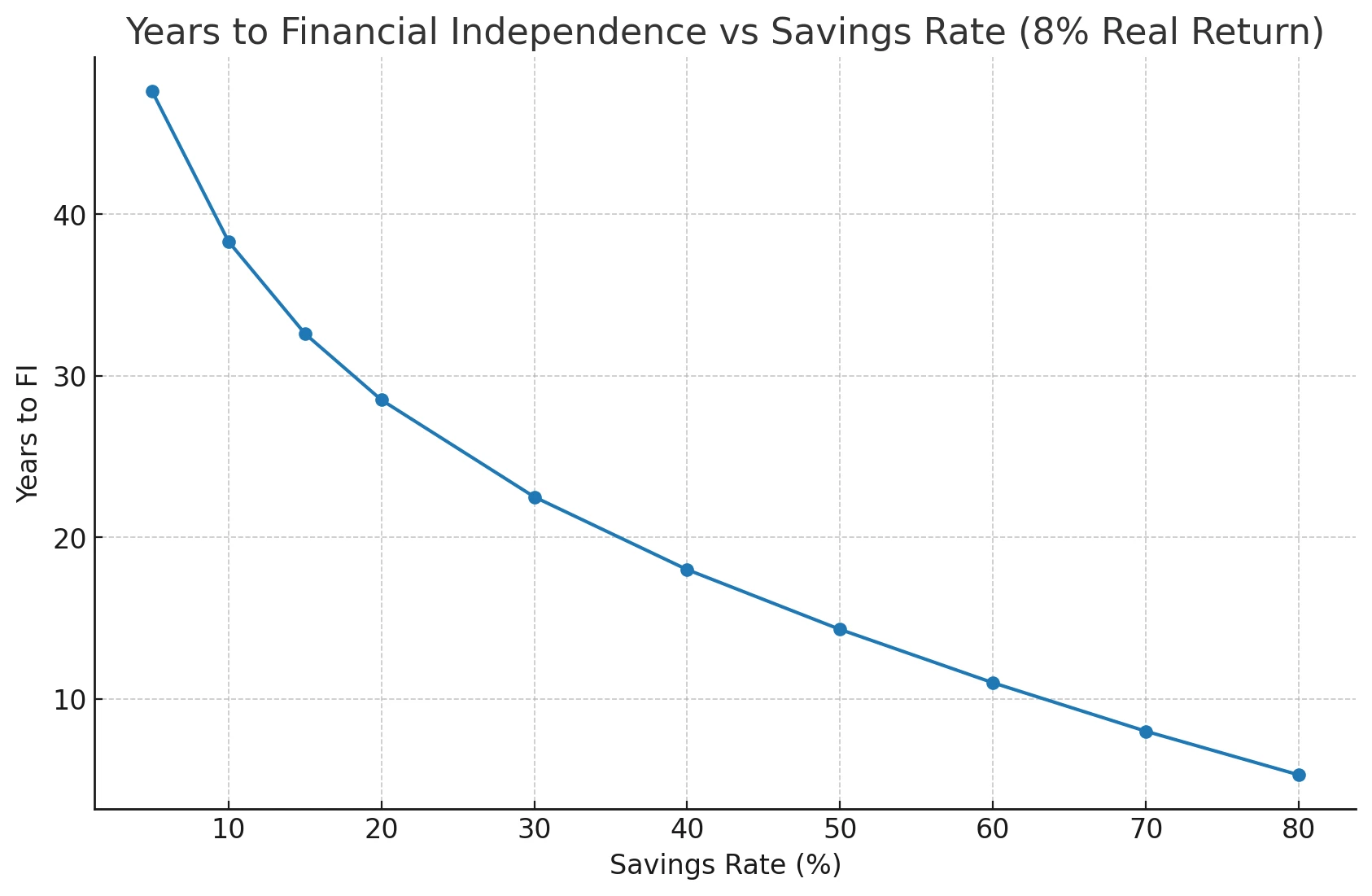
How fast can you reach Financial Independence? (8% real)
From $0 starting net worth:
- 10% savings: ~ 38.3 years
- 20% savings: ~ 28.6 years
- 30% savings: ~ 22.5 years
- 40% savings: ~ 18.0 years
- 50% savings: ~ 14.3 years
- 60% savings: ~ 11.0 years
- 70% savings: ~ 8.0 years
- 80% savings: ~ 5.3 years
Quick Questionnaire (do this once)
- Monthly take-home income: $________
- Average monthly spend: $________
- Savings rate: (1 − spend/income) × 100 = _____ %
- Annual spend: $________ → FI number ≈ 25× = $________
How to raise your savings rate without feeling poor
Hit the Big 3 first: housing, cars, food.
- Housing: consider a roommate/house-hack, move one notch down, or refinance.
- Cars: drive paid-off/used, drop luxury trims, re-shop insurance.
- Food: batch-cook 10 staple meals, shop by unit price, minimize waste.
Then the Stealth 7
Subscriptions, cell plan, internet, insurance re-quotes, fees, utilities, and small daily leaks. Audit → cut → auto-route savings to investments. For a more in-depth guide to fixing these issues, sign up for our free Mr. Money Mustache
The Real Reason Big Savers Retire Early (Kitces) — explains mathematically why modest spending (i.e., high savings rate) is the core driver of early retirement feasibility. Nerd's Eye View | Kitces.com
How to Make Up Lost Ground (Ben Carlson) — example where doubling savings rate (10%→20%) beats doubling returns (6%→12%) over two decades. A Wealth of Common Sense
Common Mistakes to Avoid (and the quick fix)
Chasing hot ROI instead of fixing spending
- Why it hurts: Markets are uncontrollable; spending is controllable.
- Fix: Lock a monthly savings-rate goal and automate transfers on payday.
Lifestyle creep after raises
- Why it hurts: Your spending rises to meet income; savings rate stalls.
- Fix: Pre-commit 50–100% of raises/bonuses to savings before they hit checking.
Counting everything as “savings”
- Why it hurts: Double-counting distorts your real savings rate.
- Fix: Count cash that stays saved/invested and debt principal reductions; don’t count money you later spend (e.g., vacation fund you drain annually).
Ignoring the Big 3 (housing, cars, food)
- Why it hurts: Tiny cuts can’t outrun oversized fixed costs.
- Fix: Right-size home, drive paid-off/used, batch-cook. Big wins first.
No emergency fund before investing
- Why it hurts: One surprise pushes you into high-interest debt.
- Fix: Build 3–6 months expenses (start with 1 month quickly) in HYS, then invest.

Conclusion: Control the Lever That Actually Moves You
Why Savings Rate Is Important comes down to this: it’s the one lever you control that shrinks your target and speeds your progress—today. Markets will do what they do. Your savings rate decides how quickly you buy back your time.
Make the decision now:
- Pick a savings-rate goal ( 20–40%+).
- Automate paycheck-day transfers (emergency fund → retirement → brokerage).
- Cut or downgrade 3 bills today.
- Lock 50–100% of future raises/bonuses to savings.
- Recheck monthly: savings rate, annual spend, progress toward 25× spending.
Do these five moves and your FI timeline compresses—no guesswork, no heroics. Want help? Use the savings-rate calculator, run the 30-Day Savings Sprint, and watch your freedom date pull forward.