
Understanding how to use trusts as part of your estate plan can significantly enhance your ability to manage wealth and protect your family's future. This guide will walk you through the different types of trusts, their benefits, and how they can be a critical component of your financial strategy.
What is a Trust?
A trust is a legal arrangement where one party, known as the trustee, holds assets on behalf of another party, the beneficiary. Trusts can be used to manage assets, reduce taxes, and ensure your wishes are honored after your death.
Types of Trusts
There are dozens of trust variations, but most people will only ever need to understand two core types. Master these first — the rest are specialized tools your attorney will recommend if and when they apply to your situation.
Revocable Living Trust
This is the most common trust and the right starting point for most families. A revocable living trust is created during your lifetime, and you remain in full control — you can change it, add assets to it, remove assets from it, or dissolve it entirely at any time. You're typically both the grantor (the person who creates it) and the trustee (the person who manages it) while you're alive.
When you die or become incapacitated, a successor trustee you've already named steps in immediately — no court involvement, no probate, no waiting. Everything passes privately and directly to your beneficiaries according to your instructions. This is the trust most estate planning attorneys build a plan around first.
Best for: Avoiding probate, maintaining control during your lifetime, planning for incapacity, and keeping your estate out of public record.
Irrevocable Trust
An irrevocable trust is the opposite in one key way: once it's created and funded, you generally cannot take the assets back or change the terms without the beneficiaries' consent. That sounds like a drawback — and it is, in terms of flexibility. But it's also the source of the trust's power.
Because you've legally given up ownership of those assets, they're no longer considered part of your taxable estate, and they're typically shielded from creditors and lawsuits. This makes irrevocable trusts the primary tool for high-net-worth estate tax planning, Medicaid planning, and asset protection strategies.
Best for: Reducing estate taxes, protecting assets from creditors or lawsuits, and qualifying for Medicaid without spending down all assets.
Other Trust Types
These are more specialized. Your estate planning attorney may recommend one depending on your circumstances:
- Special Needs Trust: Holds assets for a beneficiary with a disability without disqualifying them from government benefits like Medicaid or SSI.
- Testamentary Trust: Created by a will and only takes effect after death — it goes through probate, but then manages assets (often for minor children) ongoing.
- Spendthrift Trust: Restricts a beneficiary's ability to access or pledge their inheritance, protecting it from their creditors and impulsive decisions.
- Charitable Remainder Trust (CRT): Provides income to you or your heirs for a set period, with the remaining assets going to a charity at the end — with potential tax benefits now.
- Generation-Skipping Trust (GST): Passes assets directly to grandchildren or later generations, bypassing estate taxes that would otherwise apply at each generational transfer.
- Asset Protection Trust: Designed specifically to shield assets from future creditors and lawsuits — available as a domestic or offshore structure depending on the level of protection needed.
Benefits of Trusts in Estate Planning

When most people think about estate planning, they think about writing a will. But trusts offer a set of advantages that wills simply can't match — especially when it comes to saving money, protecting your family's privacy, and making sure your assets actually get to the right people quickly. Here's what you gain by including a trust in your plan:
Avoiding Probate — And Why That Matters
Probate is the legal process the government uses to verify that your will is legitimate and then officially transfer your assets to your heirs. In plain terms: when you die with a will (or no will at all), a court gets involved. A judge reviews your estate, creditors are notified and given time to make claims, your documents become public record, and your family waits — sometimes for months or years — before they receive anything.
The cost is real. Probate typically consumes 3–8% of your estate's gross value in attorney fees, court filing fees, and executor compensation. Here's what that looks like in practice:
- A $300,000 estate (a modest home + savings) could lose $9,000–$24,000 to probate costs before a dollar reaches your family.
- A $700,000 estate could lose $21,000–$56,000 — enough to cover a year of a child's college tuition, gone to legal fees.
When your assets are held in a trust, they never go through probate at all. The trustee simply follows the instructions you wrote and transfers assets directly. No court, no waiting, no public filing.
Keeping Your Affairs Private
Once a will enters probate, it becomes a public court document. That means anyone — a nosy neighbor, a distant relative you've never met, a creditor, or even the media — can look up exactly what you owned, what you owed, and who you left it to. This is how celebrity estate battles end up in the news.
A trust, by contrast, is a private contract. Nothing gets filed with a court. Your family's finances stay between your family. For business owners, blended families, or anyone with assets they'd rather keep out of public view, this alone is worth the cost of setting up a trust.
Protecting Beneficiaries From Themselves (and Others)

A will distributes money outright — the moment the estate closes, the heir gets the full amount with no conditions. For a responsible adult, that's fine. But what if you're leaving money to:
- A minor child? Under most state laws, children can't legally own significant assets. A court will appoint a guardian to manage the money — not necessarily who you would have chosen — until they turn 18.
- Someone with a spending problem or addiction? A lump sum could do more harm than good.
- A beneficiary with disabilities who receives government aid? Inheriting money outright can disqualify them from Medicaid or SSI benefits they depend on to live.
A trust lets you write specific instructions: "Distribute $1,000/month until my child turns 25," or "Use funds only for education and healthcare." The trustee you appoint carries out those instructions — even after you're gone.
Potential Tax Savings
For most Americans, federal estate taxes aren't a concern — the 2026 federal exemption means estates under roughly $13 million per person aren't taxed at the federal level. But state estate taxes kick in much earlier. States like Oregon and Massachusetts tax estates over $1 million, and rates can reach 16%.
Certain trust structures — particularly irrevocable trusts and strategies like AB trusts for married couples — can shift assets out of your taxable estate and reduce what your heirs owe. This isn't a DIY strategy; it requires working with an estate planning attorney. But for estates above $1–2 million, the tax savings can far exceed the cost of professional setup.
Faster Asset Distribution
Probate timelines vary by state and estate complexity, but six months to two years is common. During that time, your heirs typically can't access the frozen assets — even to pay the mortgage on a home they're inheriting. A trust eliminates this delay entirely. Once you pass, a trustee can begin distributing assets within days or weeks, not years.
How to Set Up a Trust

Setting up a trust involves several steps, each crucial to ensuring it meets your goals.
Determine Your Objectives
Identify what you want to achieve with the trust, such as asset protection, tax minimization, or providing for heirs.
Choose the Right Type of Trust
Select a trust type that aligns with your objectives, considering factors like flexibility and control.
Consult with Professionals
Work with an estate planning attorney and financial advisor to draft the trust and ensure legal compliance.
Common Misconceptions About Trusts
There are several myths surrounding trusts that can lead to confusion.
- Trusts Are Only for the Wealthy: Trusts are beneficial for estates of all sizes.
- Trusts Eliminate All Taxes: While they can reduce certain taxes, they do not eliminate tax liabilities entirely.
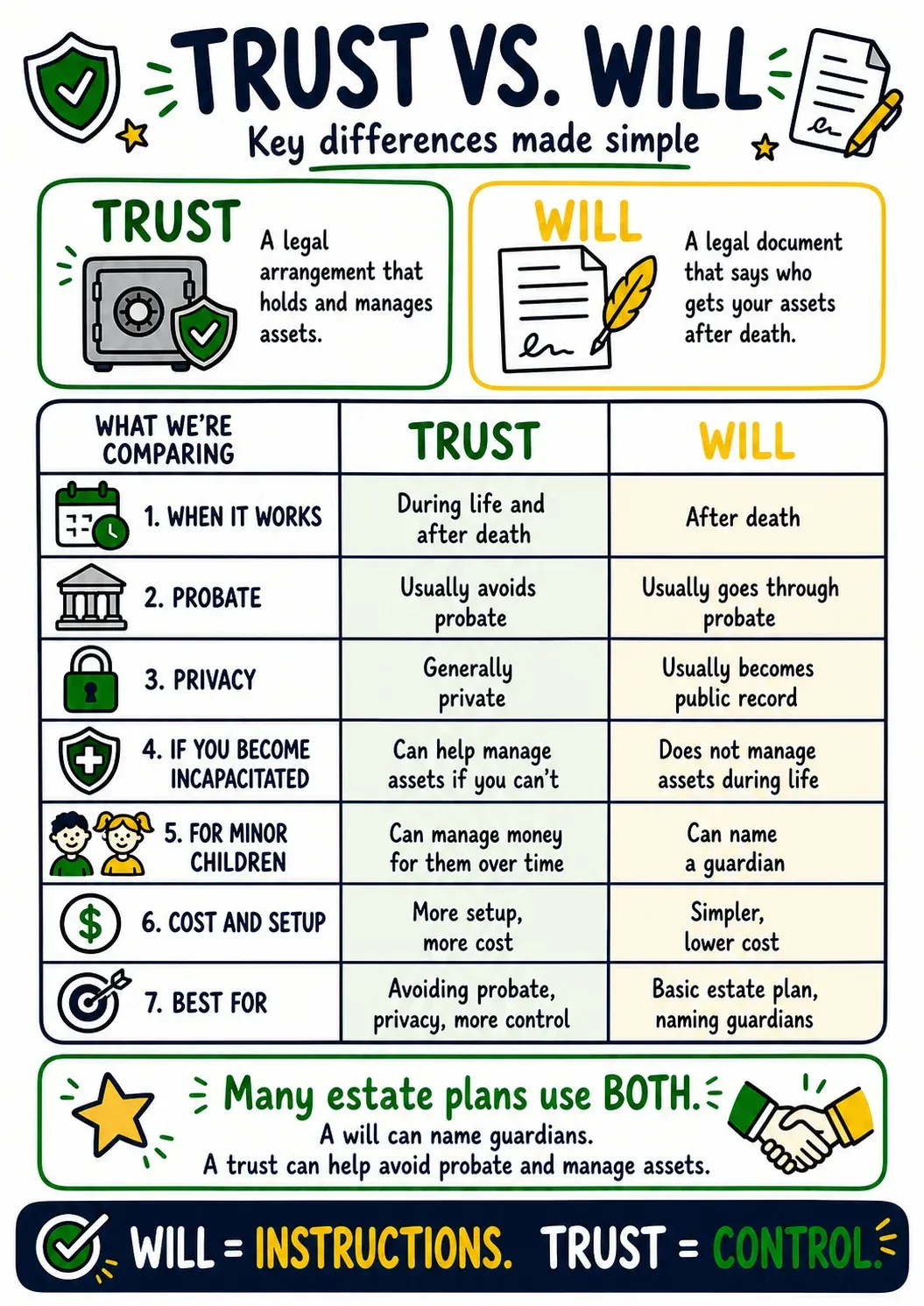
Trusts vs. Wills: Key Differences
Both trusts and wills are estate planning tools, but they work in fundamentally different ways — and choosing the wrong one (or skipping both) can cost your heirs significant time, money, and stress. Here's what actually separates them:
When They Take Effect
A will only activates after you die, and only after a court validates it through probate. A trust, by contrast, is a living legal entity — it can manage and distribute assets during your lifetime and continues seamlessly after your death without court involvement. If you become incapacitated, a trust ensures your finances are managed by your chosen trustee immediately, with no court-ordered guardianship required.
Probate: The Hidden Cost of Wills
Probate is the court-supervised process of validating a will and distributing assets. It can take anywhere from several months to multiple years depending on the state, and typically costs 3–8% of the estate's gross value in attorney fees, court costs, and executor fees. That means a $500,000 estate could lose $15,000–$40,000 before a single dollar reaches your heirs. Trusts bypass probate entirely — assets transfer directly to beneficiaries, often within weeks.
Privacy
Wills become public records once they enter probate. Anyone — including estranged relatives, creditors, or the media — can view the contents. Trusts are private documents. Your asset values, beneficiaries, and distribution terms remain confidential, which matters especially for business owners, high-net-worth individuals, or anyone concerned about family conflict.
Asset Coverage
A will can direct any asset you own at death. A trust, however, only governs assets that have been formally funded into it — meaning titled or designated to the trust. If you create a trust but forget to transfer your brokerage account into it, that account still goes through probate. This is one of the most common and costly estate planning mistakes. Wills can act as a "safety net" by including a pour-over provision that sweeps unfunded assets into the trust at death, but those assets still pass through probate first.
Flexibility After Death
Wills distribute assets outright — once the estate closes, the money is gone to the heirs with no strings attached. Trusts can hold and manage assets for years after your death. This is critical when leaving assets to minor children (who legally can't inherit directly), a beneficiary with a spending problem, a spouse in a blended family, or someone who relies on government benefits. A trust lets you define exactly when and how distributions happen.
Conclusion The Strategic Role of Trusts in Your Estate Plan

Incorporating trusts into your estate plan can offer strategic advantages in asset management, tax planning, and ensuring the fulfillment of your wishes. By understanding the types of trusts and their benefits, you can make informed decisions that protect and maximize your legacy.