
This behavioral finance playbook turns ten money psychology ideas into practical systems you can use this month. You will learn the mechanism behind each behavior, one implementation step to try, and one guardrail that keeps the idea grounded in evidence-informed design instead of magical thinking.
The goal is not to “think yourself rich.” Better financial behavior usually comes from reducing friction, making good choices easier, adding review points, and protecting yourself from common biases. Use the child guides for deeper dives, but this overview is designed to stand on its own.
How to use this behavioral finance playbook
Before you pick a tactic, define the financial behavior you want to change. “Be better with money” is too vague. Choose one observable action: save $100 per paycheck, wait 24 hours before purchases over $75, review subscriptions on the first Friday of each month, or rebalance your budget after a pay change.
Then match the behavior to the barrier. If you forget, use automation or reminders. If you panic, use a written decision rule. If you overspend around certain people, change the environment. If you avoid money because it feels shameful, use a short review ritual that focuses on facts, not blame.
Each section below follows the same pattern: the mechanism, one implementation step, and one guardrail. That structure matters because financial habits fail when they rely only on motivation. Your action today: choose the two tactics that solve your biggest current money leak, not the two that sound most inspiring.
The 10-part behavioral finance playbook
1. Harnessing the Power of Mindset: Wealth Starts Here

Mindset matters because it changes how you interpret feedback. A fixed mindset turns an overdraft, late payment, or poor investment decision into “I am bad with money.” A learning mindset turns the same event into data: what trigger, rule, or missing system caused this? That shift reduces shame and makes repair easier. Implementation step: create a “money postmortem” note with three prompts: what happened, what signal did I miss, and what rule will prevent a repeat? Use it after any financial mistake over a threshold you choose, such as $25 or $100. Guardrail: mindset is not a substitute for cash flow. If the real issue is insufficient income, medical bills, debt terms, or unstable housing costs, positive thinking cannot solve it alone. Pair mindset work with concrete budget changes, creditor conversations, or qualified professional help when needed.
Full guide: Harnessing the Power of Mindset: Wealth Starts Here
2. The Psychology of Savings: Making Saving a Habit

Saving is difficult because the present feels vivid while the future feels abstract. Decision fatigue also makes repeated manual saving unreliable. The useful mechanism is automation: move the choice to a calm moment, then let the system repeat it. Implementation step: set one automatic transfer for the day after payday, even if the amount is small. Name the destination account for its job, such as “emergency buffer,” “annual bills,” or “home repairs,” because mental accounting can make the money feel less available for impulse spending. Guardrail: do not automate an amount that causes overdrafts or high-interest credit card borrowing. Start with an amount your cash flow can survive, review it after two pay cycles, and increase only when the account balance proves the system is stable. For practical planning tools, see the Consumer Financial Protection Bureau’s savings resources.
The original Save More Tomorrow research examines how behavioral design and automatic contribution increases can support retirement saving.
Full guide: The Psychology of Savings: Making Saving a Habit
3. Delayed Gratification: The Secret to Wealth Accumulation

Delayed gratification works when it makes tradeoffs visible. The mechanism is opportunity cost: money spent now cannot also pay down debt, build an emergency fund, or invest for a future goal. This is not about never enjoying life; it is about deciding whether a purchase is worth the future option it replaces. Implementation step: create a waiting rule for nonessential purchases over a set amount. For example, wait 24 hours for purchases over $50 and seven days for purchases over $250. During the wait, write what the money would otherwise do. Guardrail: do not turn delayed gratification into deprivation. A plan that bans every enjoyable purchase often breaks under stress. Budget a guilt-free spending amount, then apply the waiting rule only outside that boundary. For purchases that may require borrowing, review the CFPB’s guidance on preparing your credit for a big purchase.
Full guide: Delayed Gratification: The Secret to Wealth Accumulation
4. Overcoming Fear: Taking Calculated Financial Risks

Fear protects you from reckless choices, but it can also keep you in choices that have hidden costs, such as holding too much idle cash while long-term goals go unfunded. The useful mechanism is pre-commitment: decide how you will evaluate risk before emotion takes over. Implementation step: write a one-page risk rule for any major decision. Include the goal, time horizon, maximum affordable loss, what information you need, and what would make you say no. This works for investing, changing jobs, starting a business, or buying a home. Guardrail: “calculated risk” does not mean ignoring downside. Do not risk rent money, emergency savings, insurance coverage, or tax obligations. If a decision involves investments, legal contracts, insurance, or taxes, get advice from a qualified professional who can review your facts.
Full guide: Overcoming Fear: Taking Calculated Financial Risks
5. Visualization Techniques: Manifesting Financial Success

Visualization is useful when it rehearses behavior, not when it pretends desire creates outcomes. The mechanism is attention and planning: picturing the steps can make obstacles easier to spot before they derail you. Implementation step: use process visualization for one goal. If the goal is to save $1,000, picture the payday transfer, the moment you decline an impulse purchase, and the weekly balance check. Then write the first calendar action connected to that picture. Guardrail: avoid magical thinking. A vision board, affirmation, or mental image does not change interest rates, debt balances, market returns, or income by itself. If visualization does not lead to a scheduled action, a rule, or a changed environment, it is motivation entertainment rather than a behavior design tool.
Full guide: Visualization Techniques: Manifesting Financial Success
6. Gratitude and Money: How a 5-Minute Daily Practice Improves Your Financial Well-Being

Gratitude can help because it interrupts the constant comparison loop that drives unplanned spending. When you notice what is already useful, enjoyable, or sufficient, you may feel less pressure to buy relief or status. Implementation step: before reviewing your budget, write three specific things your money has already done for you this week: food, transportation, a bill paid on time, a small comfort, or progress on a debt. Then review one spending category without judgment. Guardrail: gratitude should never be used to minimize real hardship. If your budget does not cover basic needs, the action is not to be more thankful; it is to seek income support, negotiate bills, use community resources, or get professional guidance. Gratitude is a regulation tool, not a replacement for material help.
Full guide: Gratitude and Money: How a 5-Minute Daily Practice Improves Your Financial Well-Being
7. Cognitive Biases: Recognizing and Overcoming Them in Finance

Cognitive biases are mental shortcuts that can distort financial decisions. Overconfidence can make you underestimate risk, loss aversion can make you avoid reasonable changes, and confirmation bias can make you search only for evidence that supports what you already want. The mechanism to use is a decision checklist, because checklists slow down automatic thinking. Implementation step: before any financial decision over a chosen threshold, answer four questions: what could go wrong, what would I think if a friend made this choice, what evidence would change my mind, and what is the cost of waiting? Guardrail: a checklist reduces blind spots; it does not make you objective. For high-stakes decisions, add an outside reviewer who is not emotionally or financially attached to the outcome. The foundational prospect theory research by Kahneman and Tversky explains how people may evaluate gains and losses differently.
Full guide: Cognitive Biases: Recognizing and Overcoming Them in Finance
8. Social Influence: Crafting a Wealth-Building Network

Social influence shapes money behavior because people copy norms around spending, debt, career moves, and lifestyle upgrades. If every invitation requires expensive meals, travel, or shopping, your budget absorbs that pressure even when no one intends harm. Implementation step: design one low-cost default with your circle. Suggest a walk, potluck, library event, home dinner, or shared savings challenge before the expensive plan becomes the default. Also choose one person for a monthly money check-in where you each name a goal and one upcoming temptation. Guardrail: do not treat people as assets or cut off every friend who spends differently. The goal is to reduce environmental pressure and increase accountability, not to build a network based only on net worth or status.
Full guide: Social Influence: Crafting a Wealth-Building Network
9. Mindfulness and Money: Staying Present to Grow Wealth

Mindfulness helps by adding a pause between impulse and action. Many money leaks happen in a narrow emotional window: boredom, stress, celebration, embarrassment, or urgency. The mechanism is interruption. Implementation step: use a 60-second purchase pause. Before buying anything nonessential, ask: what am I feeling, what need am I trying to meet, and is there a lower-cost way to meet it? If the purchase still fits your plan, make it without guilt. Guardrail: mindfulness is not a moral test. You will still make imperfect choices, and some spending is necessary even when it feels uncomfortable. Do not use mindfulness to delay bills, avoid financial conversations, or second-guess every small purchase. The point is awareness that leads to action, not endless self-monitoring.
Full guide: Mindfulness and Money: Staying Present to Grow Wealth
10. Financial Goal Setting: Turning Dreams into Reality

Goal setting works because it turns a vague desire into a target, timeline, and next action. The mechanism is specificity: “save more” creates no test, while “save $1,200 for car repairs by December 31” tells you the monthly amount and whether you are on track. Implementation step: write one financial goal with five parts: amount, purpose, deadline, funding source, and review date. If the goal is $1,200 in 12 months, the simple monthly target is $100 before any interest or account fees. Guardrail: goals must be revised when facts change. A medical bill, job loss, family need, or rent increase may require a new timeline. Adjusting the plan is not failure; ignoring reality to protect the original goal is the riskier behavior.
Full guide: Financial Goal Setting: Turning Dreams into Reality
A simple 30-day implementation plan
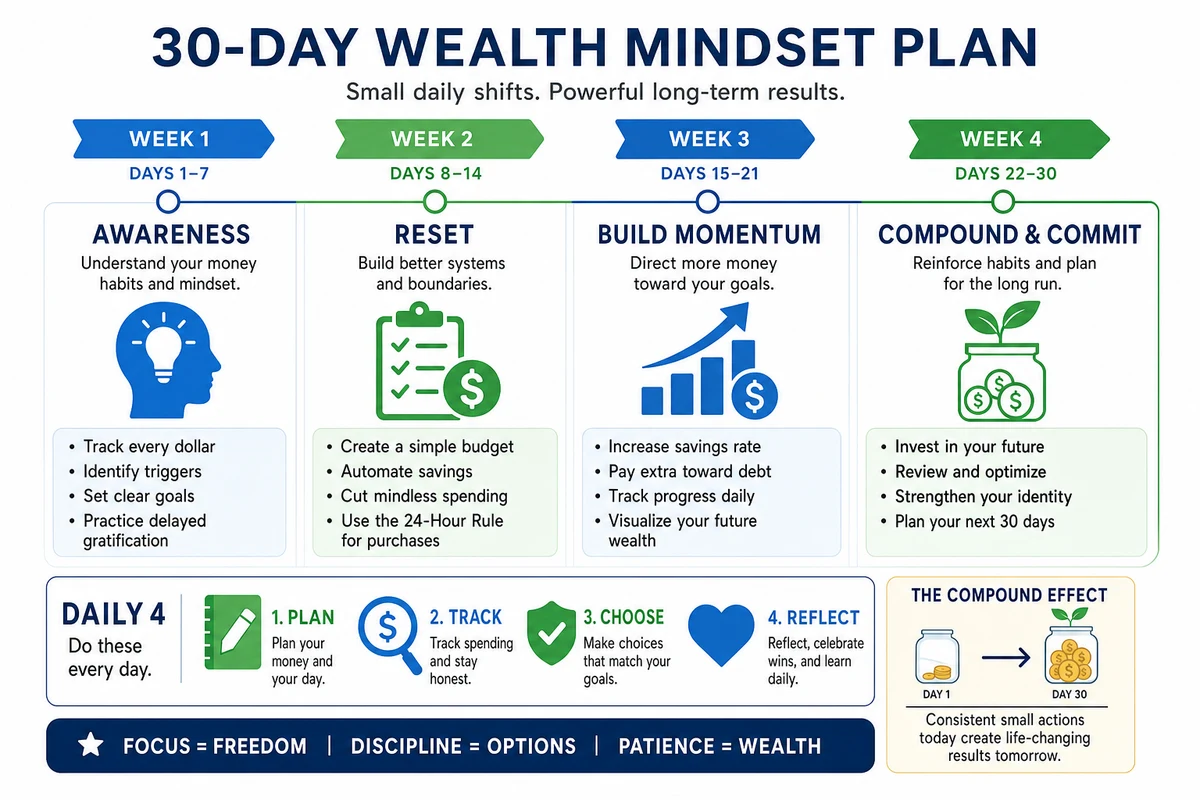
Do not try to install all ten behaviors at once. A better 30-day plan is to build one reliable money loop: notice, decide, automate, review, and adjust. Use the schedule below as a starting point and scale the amounts to your actual cash flow.
- Days 1–3: Pick one target behavior. Choose one measurable change, such as automating savings, reducing impulse purchases, reviewing debt, or setting a goal. Write the current baseline so you can compare later.
- Days 4–7: Add friction to the bad default. Remove saved cards from shopping apps, unsubscribe from one promotional email category, set a waiting rule, or move spending money into a separate account.
- Days 8–10: Automate the good default. Schedule a transfer, calendar a weekly money review, set a bill reminder, or create a recurring check-in with an accountability partner.
- Days 11–17: Use one reflection tool. Try the money postmortem, gratitude note, purchase pause, or bias checklist. Keep it short enough that you will actually repeat it.
- Days 18–24: Review the numbers. Compare your baseline with the current result. Look at account balances, debt movement, missed payments, unplanned purchases, or whatever metric matches your target behavior.
- Days 25–30: Adjust the system. Increase an automatic transfer only if cash flow supports it, tighten a guardrail that failed, or choose the next behavior after the first one feels stable.
Your action today: put the Day 1 task on your calendar and choose the smallest version that still counts. A $10 transfer that repeats is more useful than a dramatic promise you abandon by next week.
How to tell evidence-informed behavior design from magical thinking
A behavior design tool changes the conditions around a decision. It makes the desired action easier, the risky action slower, the feedback clearer, or the review more consistent. Examples include automatic transfers, written decision rules, waiting periods, checklists, calendar reminders, separate accounts, and scheduled reviews.
Magical thinking skips the mechanism. It claims that imagining wealth, repeating affirmations, or feeling abundant will directly produce money without a change in behavior, resources, risk, or decision quality. That framing is tempting because it feels simple, but it can lead people to ignore math, delay hard conversations, or blame themselves when unsupported claims do not work.
Use this test before adopting any tactic: What behavior will change? When will it happen? How will I know it happened? What downside does the guardrail prevent? If you cannot answer those four questions, simplify the tactic until you can.
What to do next
Start with the behavior that creates the most immediate financial stability. For many readers, that means automating a small emergency transfer, creating a waiting rule for impulse purchases, or writing one specific financial goal. If your situation involves taxes, legal issues, insurance, investments, benefits, or unmanageable debt, use this playbook for behavior support while getting advice from an appropriately qualified professional.
Your next step is simple: choose one tactic, schedule the first action within 24 hours, and review the result in seven days. After that, use the child guides above to deepen the one behavior you are actually practicing.