
To budget for nonmonthly expenses, list every predictable annual, seasonal, and irregular cost, subtract what you have already saved, and divide the remaining amount by the months until it is due. This sinking-fund method turns large bills into manageable monthly deposits and shows your true cost of living before those bills become credit-card debt.
A bill is not unexpected simply because it is absent from this month’s statement. Car registration, holiday travel, insurance premiums, school supplies, and routine home maintenance may vary in amount, but their purpose and general timing are usually foreseeable. Planning for them makes each expense a controlled cash-flow decision instead of a recurring financial emergency.
Which nonmonthly expenses belong in a sinking fund?
A sinking fund is cash accumulated gradually for a specific future expense. It differs from an emergency fund because the category is known even when the exact amount or payment date is not.
A true financial emergency is necessary and meaningfully unpredictable. Examples may include a sudden job loss, urgent medical care, or major damage that could not reasonably have been anticipated. A nonmonthly expense occurs less often than once a month, but you know—or should reasonably expect—that it will eventually arrive.
Consider a vehicle. You may not know whether it will need a battery or brake repair next year, but tires, maintenance, registration, and mechanical wear are normal costs of ownership. Treating every repair as an emergency understates the vehicle’s actual monthly cost.
Common sinking-fund categories include:
- Annual or semiannual insurance premiums
- Vehicle registration, inspections, maintenance, and replacement tires
- Property taxes or association assessments not included in a mortgage payment
- Holiday gifts, birthdays, weddings, and planned travel
- School supplies, activity fees, camps, and seasonal childcare
- Professional licenses, membership renewals, and tax-preparation fees
- Pet checkups, vaccinations, grooming, and routine medications
- Appliance servicing and ordinary home maintenance
- Technology, furniture, or equipment that wears out on a roughly predictable cycle
An emergency fund still protects against serious uncertainty. Keeping it separate from sinking funds helps you see whether your emergency reserve is actually intact rather than repeatedly spent on annual bills. Use this guide to build an emergency fund for genuine financial shocks.
There is an important edge case: a known category can still arrive earlier than expected. If an essential car repair is needed tomorrow before its sinking fund is full, emergency savings may be the appropriate short-term source. Afterward, replenish the emergency fund and increase the vehicle reserve if the original estimate was too low.
Action: Review the last 12 months of transactions and highlight every large charge you called “unexpected.” Reclassify any expense that could reasonably recur.
How do you find annual expenses missing from your monthly budget?

Build a complete annual expense inventory
Start with records rather than memory. Review bank and credit-card statements, email receipts, insurance notices, tax documents, renewal reminders, and your calendar for at least the previous 12 months. Looking back 24 months is better for maintenance and replacement costs because one quiet year can make an irregular expense appear to have disappeared.
Place each expense in one of three forecasting categories:
- Fixed and dated: The amount and due date are known, such as a $240 professional license due in September.
- Variable but recurring: The category and general timing are known, but the amount changes, such as holiday travel or school expenses.
- Ownership reserves: The timing is uncertain, but maintenance or replacement is inevitable, such as vehicle repairs or appliance replacement.
For a fixed expense, use the amount on the latest notice. For a variable expense, begin with last year’s total and adjust for known changes in plans. For an ownership reserve, examine service history, current condition, warranties, and recent quotes. A documented estimate reviewed regularly is more useful than waiting for a perfect forecast.
Avoid counting the same cost twice. If property taxes and homeowner insurance are included in an escrowed mortgage payment, they are already part of the monthly payment. If an employer deducts an insurance premium from every paycheck, do not create a second annual target for it.
Also separate obligations from preferences. “Holiday spending” is too broad to guide a decision. Break it into travel, gifts, meals, and events so you can reduce one category without pretending the entire holiday cost is fixed.
This inventory may reveal that your real monthly spending is materially higher than the bills due every 30 days. Focus first on the few categories that create most of the financial pressure, an approach consistent with the 80/20 approach to personal finance.
Action: Create a list with five columns: expense, expected amount, amount already saved, due month, and confidence level. Mark each estimate as high, medium, or low confidence so you know what to verify.
How much should you save for each nonmonthly expense?

Convert each future bill into a monthly deposit
For an expense with a deadline, subtract the amount already saved from the target and divide the result by the number of deposits remaining before payment. Use pay periods instead of months if you prefer to save from every paycheck.
Suppose an annual auto insurance premium is expected to be 1,200 dollars. You have 300 dollars saved, and the bill is due in six months. The remaining need is 900 dollars:
($1,200 − $300) ÷ 6 = $150 per month
After paying the premium, restart the fund immediately. If the next premium is still estimated at 1,200 dollars and is 12 months away, the ongoing deposit becomes 100 dollars per month. Waiting for the next renewal notice would compress the same bill into fewer deposits.
For an expense without a firm date, estimate the annual cost and divide by 12. If routine vehicle service and repairs are expected to total 900 dollars per year, save 75 dollars per month. If actual costs repeatedly reach 1,500 dollars, update the target to 125 dollars per month rather than treating the difference as a surprise.
A planning cushion can help with variable expenses. Adding 5% to 10% is a rule of thumb, not a requirement or forecast. Use a cushion only when past variation supports it. If money is tight, funding a realistic base amount is better than setting an inflated target you cannot sustain.
Short-term sinking-fund money generally needs to be accessible and protected from market volatility. You may use one savings account with a ledger or multiple bank “buckets.” Whichever structure you choose, record how much belongs to each category so money reserved for insurance does not appear available for travel. Review the account’s fees, withdrawal rules, interest rate, and applicable deposit protections for your jurisdiction. The CFPB saving tools and account guidance provide a useful starting point for comparing the saving process.
Once the deposit amount is stable, automate it for the day after each payday. The process in automating recurring financial tasks can reduce missed transfers without removing the need for periodic review.
Action: Calculate every required monthly deposit and add them together. Treat that total as part of your real monthly cost of living, not as optional savings.
What does a realistic sinking-fund budget look like?

Assume a household reviews its finances in January and identifies five upcoming costs. These are example estimates, not recommended spending targets.
| Expense | Target | Saved | Months left | Monthly deposit |
|---|---|---|---|---|
| Car registration | $360 | $60 | 6 | $50 |
| Auto maintenance | $1,200 | $300 | 12 | $75 |
| Holiday spending | $900 | $0 | 10 | $90 |
| Pet care | $600 | $120 | 12 | $40 |
| Professional license | $240 | $0 | 8 | $30 |
| Total monthly deposit | $285 | |||
The household needs $285 per month under these assumptions. Across the five categories, the targets total $3,300, while $480 has already been saved. The remaining $2,820 is not divided evenly because each expense has a different deadline.
If the household saves nothing, the underlying expenses do not disappear. They arrive as several large bills instead of monthly allocations. Suppose the $900 holiday target goes on a credit card. The actual cost can exceed $900 if the balance accrues interest, with the calculation depending on the issuer’s annual percentage rate, balance method, payments, and disclosures. The Consumer Financial Protection Bureau explanation of credit-card interest describes how issuers may calculate that interest.
Expense cycles can also overlap. A household may still be paying for last December when the next holiday season begins. That creates repeated debt because the event recurs faster than the previous balance is repaid.
Action: Add your calculated monthly total to your budget. If it does not fit, keep the number visible—the shortfall is information needed to prioritize the next dollar.
How should you prioritize sinking funds when money is limited?

Rank costs by consequence, deadline, and flexibility
If your calculated deposits total $400 per month but only $175 is available, do not spread the $175 equally across every category. Fund expenses according to the damage caused by missing them.
- Protect income, housing, health, and compliance. Prioritize required professional licenses, essential transportation repairs, necessary insurance, property-related obligations, and other costs where nonpayment could threaten work, housing, coverage, or legal compliance.
- Cover near-term fixed deadlines. A registration bill due in two months generally needs attention before a flexible purchase expected next year.
- Avoid high-cost borrowing. Favor unavoidable categories that would otherwise land on a credit card or expensive loan.
- Preserve essential assets. Fund maintenance that keeps a necessary home, vehicle, or work tool functional before cosmetic upgrades.
- Reduce flexible lifestyle targets. Gifts, travel, celebrations, and optional renewals can often be scaled down, postponed, or replaced.
For example, a household with $175 available might put $50 toward registration, $75 toward vehicle maintenance, $30 toward a required professional license, and $20 toward holiday spending. It must then reduce the holiday plan, adjust other flexible expenses, or find additional cash rather than assuming every original target remains affordable.
Do not automatically drain or stop building all emergency savings to fund annual bills. Without any cash buffer, one genuinely unpredictable event can undo the plan. A practical approach is to maintain a starter emergency reserve while funding the most urgent predictable obligations. The risks of treating a credit limit as that reserve are covered in why credit is not a substitute for emergency savings.
Action: Assign every available dollar in priority order. Write down which targets will remain underfunded and the specific change—smaller target, later date, lower spending, or additional income—needed to close each gap.
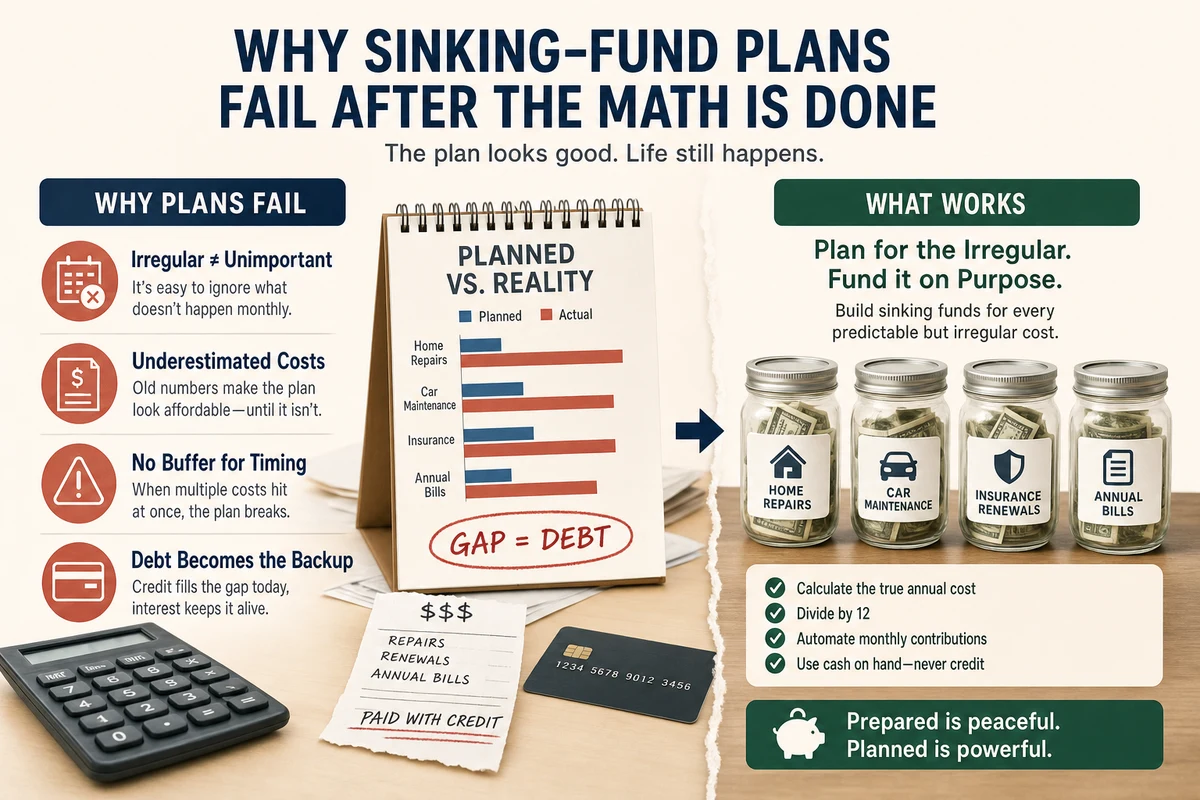
Why do sinking-fund plans fail after the math is done?
Create rules for transfers, withdrawals, and reviews
The formula is straightforward, but weak account rules can undermine it. One common mistake is saving without naming the purpose. A 2,000 dollars balance may look available even though 1,500 dollars is already committed to insurance, registration, and repairs.
Another mistake is failing to restart a fund after using it. Paying an annual premium closes the current cycle and starts the next one. Resume the transfer immediately instead of waiting for another renewal notice.
Watch for these additional failure modes:
- Optimistic estimates: Budgeting $300 for a category that cost about $700 in each of the last three years creates a foreseeable shortfall.
- Outdated assumptions: A move, older vehicle, new pet, coverage change, or family change can make last year’s target obsolete.
- Rigid optional categories: Money reserved for a flexible trip may need to be reassigned when an essential category is underfunded.
- Raiding funds without recording it: If you borrow from one category, update both balances and create a repayment plan.
- Funding wants while expensive debt grows: Optional sinking funds may need to shrink while required payments and high-cost balances are addressed.
- Financing by default: A monthly payment can appear manageable while interest and fees reduce room for future obligations. Compare the full cost of borrowing with saving first using the CFPB guidance on preparing for a major purchase.
If debt already exists, continue making required payments while preserving enough cash for known, near-term necessities. Sending insurance money to a credit card and then charging the premium back to the same card may not improve the underlying position. The Federal Trade Commission provides consumer guidance for evaluating debt repayment and debt-relief options. For a consolidation offer, compare the total interest, fees, term, collateral requirements, and whether the old balances are likely to return. Review the broader risks in this guide to evaluating a debt-consolidation loan.
Action: Schedule a 10-minute review every month. Reconcile balances, compare forecasts with actual spending, restart funds after withdrawals, and close categories that no longer serve a real purpose.
What should you do before the next predictable bill arrives?
Start with the nonmonthly expense most likely to create debt in the next 90 days. A working transfer today is more valuable than a perfect system built after the bill arrives.
- Today: Review at least 12 months of transactions and list recurring nonmonthly charges.
- Next: Record each target, current balance, deadline, and confidence level.
- Then: Calculate the required deposit and rank every category by consequence and due date.
- This payday: Automate the highest-priority transfer, even if you cannot fund the entire plan yet.
- This month: Reduce or reschedule one flexible target when required obligations exceed available cash.
- After each payment: Restart the category for its next cycle and replace the estimate with the actual amount paid.
If the numbers still do not fit after optional spending is reduced, your budget is exposing a structural gap between income and the true cost of your commitments. Possible responses include changing an unaffordable asset, requesting different billing dates, revising discretionary plans, comparing insurance options, or increasing income. Insurance, tax, and legal choices depend on your jurisdiction and personal facts, so use the appropriate licensed professional when a change could affect coverage, taxes, or legal obligations.
Avoid hiding a persistent gap with new financing. Borrowing may be reasonable in some circumstances, but the payment must fit alongside maintenance, insurance, and the next replacement cycle. Compare those tradeoffs in the full cost and tradeoffs of financing large purchases.
Your first priority is not opening a perfect collection of accounts. Identify the next unavoidable nonmonthly expense, calculate the deposit required before its deadline, and transfer money toward it this payday. Then fund the next highest-priority category until predictable bills stop behaving like emergencies.