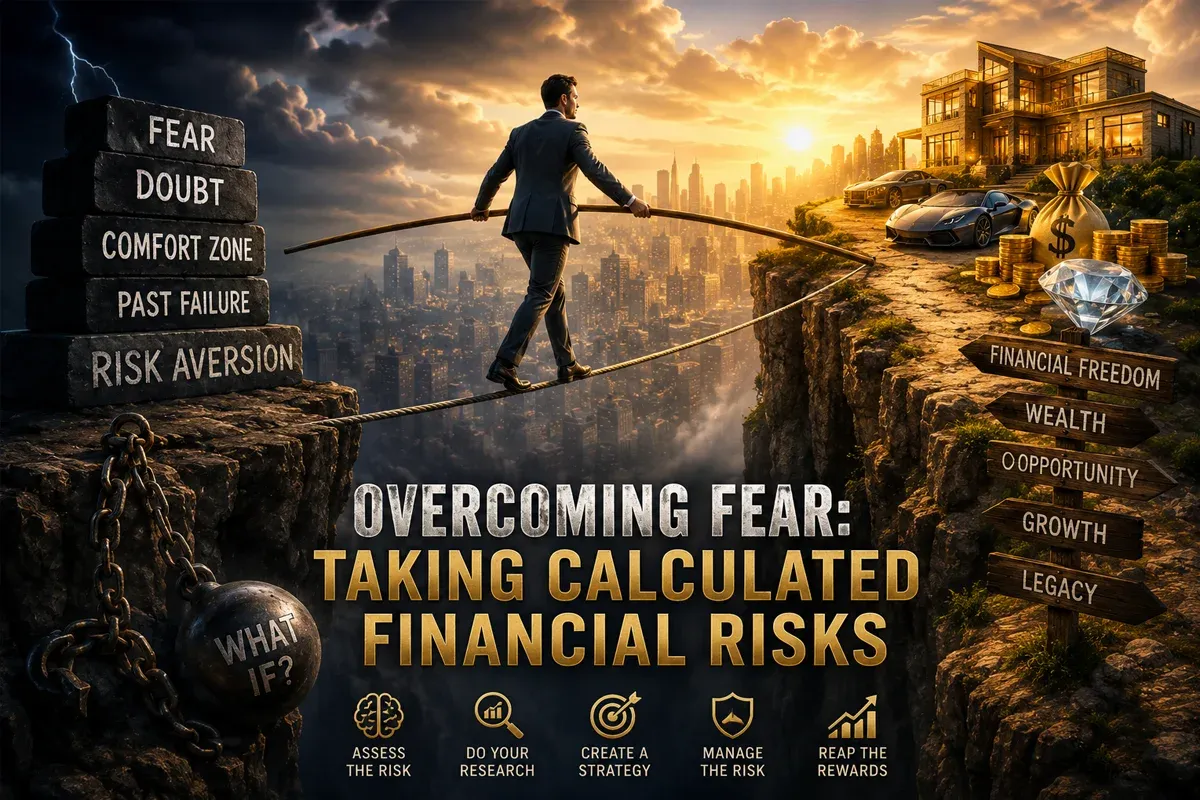
Fear of financial failure doesn't just feel bad — it literally rewires how your brain makes decisions. Neuroscientists and behavioral economists have spent decades proving that the same primal circuits that kept our ancestors alive in the wild are sabotaging modern investment portfolios every single day. Understanding the deep psychology behind financial fear is the only real way to break its grip.
The Neuroscience of Financial Fear
When you face a potential financial loss, your brain doesn't treat it as an abstract calculation — it treats it as a survival threat. The amygdala, a small almond-shaped structure in the brain's temporal lobe, fires up in response to perceived danger, triggering what neurologist Daniel Goleman famously called an amygdala hijack — a moment when your emotional brain overrides your rational prefrontal cortex.
In practical terms, this means watching your portfolio drop by 10% can provoke the same neurological stress response as being chased by a predator. Your body floods with cortisol and adrenaline, your thinking narrows to short-term survival, and long-term rational strategies fly out the window. This isn't a character flaw — it's ancient wiring operating in a modern context.

Loss Aversion: The Cornerstone of Financial Fear
In 1979, psychologists Daniel Kahneman and Amos Tversky published their landmark Prospect Theory, which fundamentally changed how economists understand human decision-making. Their research demonstrated that people don't weigh gains and losses equally — losses feel approximately 2 to 2.5 times more painful than equivalent gains feel pleasurable.
This phenomenon, known as loss aversion, explains why investors panic-sell during market corrections even when their long-term thesis hasn't changed. The psychological pain of watching $10,000 evaporate feels far worse than the pleasure of gaining $10,000 in the first place. This asymmetry is hardwired, not logical — and it is arguably the single greatest enemy of long-term wealth building.
The DALBAR Effect: How Fear Costs Investors Billions
Every year, DALBAR's Quantitative Analysis of Investor Behavior documents the gap between what the market earns and what the average investor actually takes home. Consistently, the typical equity fund investor has underperformed the S&P 500 by several percentage points annually — not because they picked bad funds, but because they bought high and sold low, driven by fear and greed.
Over a 30-year investment horizon, that behavior gap can cost hundreds of thousands of dollars in compounding returns. The market rewards patience and punishes panic. Fear-driven selling at the worst possible moment — the bottom of a correction — locks in losses that a calm, systematic investor would have fully recovered within months or years.

Behavioral Biases That Amplify Financial Fear
Loss aversion doesn't work alone. A cluster of interconnected cognitive biases — all documented extensively in behavioral economics research — conspire to keep fear at the wheel:
- Recency Bias: After a market crash, the brain over-weights recent losses and assumes the trend will continue indefinitely, even when historical data says otherwise.
- Herding Behavior: Social proof is a powerful psychological force. When everyone around you is selling, the brain interprets “safety in numbers” — even when the crowd is wrong. Research on FOMO's effects on investment behavior shows that fear of missing out systematically distorts individual decision-making.
- Status Quo Bias: The discomfort of change feels worse than the potential upside. This keeps people in low-yield savings accounts or out of the market entirely, long past the point when action would benefit them.
- Overconfidence Paradox: Many investors oscillate between paralyzing fear and reckless overconfidence. Research by Terrance Odean at UC Berkeley tracked individual investor performance and found that overconfident trading was a leading cause of poor long-term returns.
Understanding the Fear of Financial Risks
Beyond the neuroscience, financial fear is often rooted in deeply personal experiences — growing up in financial scarcity, witnessing a parent lose everything, or suffering an early investment setback. These experiences create what psychologists call cognitive distortions: automatic, exaggerated negative thought patterns that make risks seem more catastrophic than they are.
Common financial cognitive distortions include catastrophizing (“If this investment drops, I'll lose everything”), overgeneralizing (“I lost money once, so investing always leads to loss”), and all-or-nothing thinking (“Either I make a safe bet or I gamble recklessly”). Identifying these distortions is the starting point for change.

Assess Your Financial Risk Tolerance
Your risk tolerance is the level of risk you're comfortable taking with your investments. Critically, research shows risk tolerance has two components that often diverge: your financial capacity for risk (what you can objectively afford to lose) and your emotional tolerance for risk (how much volatility your psychology can handle without triggering panic). Getting both right is essential.
Identify Your Financial Goals
Start by identifying what you want to achieve financially and — crucially — when you need the money. A 25-year-old saving for retirement in 40 years has a completely different risk profile than a 55-year-old planning to retire in 10. Clear time horizons transform abstract “risk” into a concrete, calculable variable that removes much of the emotional charge.
Evaluate Your Financial Situation
Consider your current financial status, including income, expenses, debts, and savings. A strong emergency fund (3–6 months of expenses in liquid savings) is not just practical preparation — it's psychological armor. People with adequate emergency funds make dramatically calmer investment decisions because they're not one setback away from needing to liquidate assets.
Build your financial safety net firstUse Risk Assessment Tools
Many brokerages and financial planning platforms offer risk tolerance questionnaires. The key is to complete them when you're emotionally neutral — not in the middle of a market sell-off, when fear will skew your answers toward excessive caution.
Evidence-Based Techniques to Overcome Financial Fear
Once you've mapped both your financial and emotional risk tolerance, evidence-backed strategies can help you rewire fear-driven behavior:
- Pre-Commitment Strategies: Set your investment rules in advance, in writing, during calm market conditions. When your amygdala fires during a correction, you don't have to make a new decision — you already made it.
- Systematic Investing (Dollar-Cost Averaging): Automating regular contributions removes the need to make emotionally charged timing decisions. You buy more shares when prices are low and fewer when they're high — mechanically, without fear entering the equation.
- Reframe Volatility as Opportunity: Cognitive reframing is a core technique from cognitive-behavioral therapy (CBT). Instead of “the market is crashing,” practice thinking “I am buying quality assets on sale.”
- Start Small and Build Evidence: Starting with smaller amounts lets you accumulate real-world data that challenges the catastrophic narratives your brain has constructed.
- Diversify to Reduce Objective Risk: Spreading investments across uncorrelated asset classes genuinely reduces downside volatility — which in turn reduces the stimuli that trigger the amygdala response in the first place.

The Role of Financial Therapy
For those whose financial fear is deeply rooted in childhood experiences, trauma, or identity, standard financial advice may not be enough. Financial therapy — a discipline that blends financial planning with therapeutic psychology — specifically addresses the emotional barriers that prevent people from taking rational financial action.

Leverage Financial Formulas
One of the most powerful antidotes to emotional decision-making is the imposition of math. When you replace gut feelings with formulas, you give your prefrontal cortex — the rational brain — concrete tools to override the amygdala. Here's the foundational formula for evaluating whether an investment risk is worth taking:
A Sharpe Ratio above 1.0 is generally considered acceptable — meaning you're being compensated for the volatility you're absorbing. This formula transforms the vague, paralyzing question “Is this too risky?” into a specific, answerable calculation. When fear says “this feels dangerous,” math can say “the risk-adjusted return is 1.4 — historically strong.”

Case Study: The Psychology Behind Warren Buffett's Fearlessness
Warren Buffett's famous maxim — “Be fearful when others are greedy, and greedy when others are fearful” — is not just a pithy saying. It is a deliberate psychological system designed to exploit the predictable irrationality of loss-averse, amygdala-driven investors.
During the 2008 financial crisis, when the DALBAR data shows most retail investors were panic-selling at the bottom, Buffett deployed capital aggressively while fear was at its peak. His competitive advantage wasn't superior information — it was superior psychological architecture. This is the foundational insight of behavioral finance: markets misprice assets when collective fear overwhelms rational analysis.
Why investing is not gambling — the distinction that changes everythingActionable Steps to Implement Today
Set Clear, Time-Bound Goals
Define specific, measurable financial goals with concrete time horizons. “I want to have $500,000 by age 65” is actionable; “I want to be wealthy someday” is not. Clear goals short-circuit the amygdala's tendency to catastrophize by replacing vague dread with a specific roadmap.
Automate and Then Ignore
Set up automatic contributions to your investment accounts and then deliberately reduce how often you check them. The DALBAR research makes clear that the biggest enemy of investor returns is the investor themselves — and automation is the most reliable way to take emotion out of the equation.
Seek Professional Guidance — Including the Behavioral Kind
Consider working with a fee-only financial advisor who practices behavioral coaching. Vanguard has estimated that a good financial advisor adds roughly 1.5% in annual net returns through behavioral coaching alone: preventing panic selling, maintaining rebalancing discipline, and keeping clients invested through volatile markets. The value of a great advisor is often less about what they tell you to buy and more about what they stop you from selling.
Conclusion
Overcoming the fear of financial risks is not about eliminating fear — it is about building the psychological and systemic infrastructure to prevent fear from driving decisions. The neuroscience of the amygdala hijack, the behavioral economics of loss aversion, and decades of DALBAR data all point to the same conclusion: the investors who build real wealth are not the ones who feel no fear, but the ones who have learned to act rationally in spite of it.
Knowledge is the first antidote. Pre-commitment systems are the second. And a clear-eyed understanding of your own psychological vulnerabilities is the foundation everything else rests on.
Stock market myths debunked: why staying out is the real risk