
Mark Cuban’s sales strategy can be reduced to one practical rule: understand the customer’s problem, then explain a specific and credible reason your solution is worth buying. A strong product is not enough if customers cannot quickly connect its features to a result they value.
This guide turns that principle into a repeatable sales process. You will learn how to interview customers, write a focused value proposition, prepare for objections, improve your pitch, and measure whether the changes produce more revenue rather than merely more activity.
Why does understanding the customer matter more than describing the product?
Customers rarely buy a feature for its own sake. They buy a different future: less wasted time, lower risk, more revenue, fewer mistakes, greater convenience, or relief from a recurring frustration. Selling begins by identifying which result matters enough for the customer to spend money, switch providers, or change an established habit.
This distinction prevents a common mistake: explaining what a product does before establishing why the customer should care. A bookkeeping service might advertise monthly reports, automated categorization, and accounting software integrations. Those are capabilities. The customer may actually want to stop losing Sunday evenings to spreadsheets and feel prepared when quarterly taxes are due.
Product-centered message
“Our platform includes automated scheduling, reminders, reporting, and payment integrations.”
The message lists features but leaves the customer to calculate their value.
Customer-centered message
“Reduce missed appointments and collect payment faster without adding administrative work.”
The message connects capabilities to an operational and financial benefit.
The customer-centered version does not abandon product details. It introduces them after the desired result is clear. Features then serve as evidence explaining how the benefit will be delivered.
This is also why selling cannot be completely delegated to a script. A script can provide structure, but the seller still has to listen, ask follow-up questions, and adjust the explanation to the buyer’s circumstances. The same service may create value by saving time for one buyer and reducing costly errors for another.
The principle complements broader business systems such as using leverage to expand business capacity. Leverage can increase the number of people you reach, but it will also amplify an unclear message. Validate the message before scaling it.
Action: Replace your opening product description with one sentence describing the customer’s costly or frustrating current situation.
How do you identify a problem customers will pay to solve?

Collect the customer’s language before writing the pitch
Start with conversations, support messages, reviews, lost-sale notes, and observations of how people currently handle the problem. The goal is not to ask whether someone likes your idea. People can praise an idea without paying for it. Ask about actual behavior, recent problems, and existing spending instead.
Useful discovery questions include:
- What happened the last time you experienced this problem?
- How are you solving it now?
- How much time, money, or opportunity does the current approach consume?
- Who else is affected or involved in approving a solution?
- What have you already tried, and why was it insufficient?
- What would have to be true for changing solutions to feel worthwhile?
Ask for examples rather than predictions. “Tell me about the last missed appointment” generally produces more useful evidence than “Would you buy appointment software?” Recent behavior reveals the customer’s priorities, constraints, and willingness to act.
The U.S. Small Business Administration’s market research guidance distinguishes direct research, such as interviews and surveys, from existing market information. Use both. Market reports can estimate the size of a category, while conversations reveal why a specific customer chooses, delays, or rejects a purchase.
After 10 to 15 conversations, group the answers by repeated problem, affected customer, current alternative, consequence, and desired result. That interview count is a practical starting point, not proof of market demand. Continue until the major themes stop changing, then test the strongest theme with a real offer.
Do not treat frameworks from courses or business books as substitutes for customer evidence. They can improve the questions you ask, but your customers’ behavior must determine whether the proposed problem is commercially important.
Customer problem evidence checklist
- The customer describes a recent instance of the problem
- The problem has a measurable cost, delay, risk, or inconvenience
- The customer already spends money or effort on an alternative
- Someone has the authority and budget to approve a solution
- The desired result is specific enough to recognize when achieved
Action: Schedule five conversations this week and record the exact phrases customers use to describe the problem, consequence, and desired outcome.
How do you turn customer research into a strong value proposition?

Write one testable value proposition
A value proposition is a concise explanation of who the offer helps, what valuable result it creates, how it works, and why the claim is believable. It is not necessarily a slogan. Think of it as the central hypothesis behind your sales message.
Use this structure:
For [specific customer] who struggles with [specific problem], our [offer] helps produce [credible benefit] by [mechanism], unlike [current alternative].
For example: “For independent dental practices losing revenue to late cancellations, our reminder and wait-list service helps fill more appointment gaps by contacting confirmed replacement patients automatically, unlike a manual call list.”
The statement is specific about the customer, problem, benefit, mechanism, and alternative. It does not claim that every cancellation will be filled or promise a precise revenue increase without evidence.
A useful benefit should pass three tests. It must matter to the customer, be distinguishable from the current alternative, and be supported by a credible mechanism or evidence. “Improve your business” fails because the result is vague. “Prepare payroll in 20 minutes instead of rebuilding timesheets manually” is concrete enough to test.
If research identifies several benefits, lead with the one that most strongly affects the buying decision. The 80/20 principle of focusing on the highest-impact inputs applies to communication too: one clear, valuable outcome is usually easier to understand than a long list of loosely connected advantages.
Credibility can come from a demonstration, limited pilot, transparent calculation, relevant case study, warranty, documented process, or verifiable customer result. Use the strongest evidence you actually possess. A young business without case studies can offer a paid pilot with narrow success criteria rather than invent authority.
Ethical specificity separates useful selling from manipulation. Artificial urgency, vague income claims, hidden conditions, and unsupported testimonials may pressure someone into a decision, but they do not prove that the offer solves the stated problem. Confidence is not a substitute for evidence.
Action: Draft three value propositions, show them to five qualified prospects, and retain the version they understand most quickly—not the version your team finds most clever.
How should you prepare for objections without becoming defensive?

Build an objection map before the sales conversation
An objection is information about unresolved risk. “It costs too much” could mean the customer does not understand the economic benefit, lacks available cash, doubts implementation will work, or has compared the offer with a cheaper alternative. Responding with an immediate discount may leave the real concern unanswered.
Create an objection map with four columns: the customer’s words, the underlying concern, the question you should ask, and the evidence or option that could resolve it.
| Objection | Possible concern | Useful response |
|---|---|---|
| “It is too expensive.” | The benefit is unclear or cash flow is limited. | Compare the price with the current cost, then ask whether value or timing is the barrier. |
| “We need to think about it.” | A decision-maker, requirement, or risk remains unidentified. | Ask what information the decision still requires and who must participate. |
| “Switching will be difficult.” | Implementation effort could exceed the benefit. | Show the transition plan, responsibilities, timeline, and available support. |
| “Your company is too new.” | The buyer fears failure or poor support. | Offer a limited pilot, milestone payments, references, or a clearly defined exit. |
A good response follows four moves: acknowledge the concern, clarify what it means, answer with relevant evidence, and confirm whether the answer resolves it. Do not overload the buyer with every fact you know. Address the specific risk they identified.
Price objections deserve particular care. Show the total price, payment timing, implementation expenses, training needs, and likely operating impact. If you claim the offer saves money, compare all relevant costs over the same period instead of comparing your monthly price with only one part of the customer’s current expense.
The SBA guide to calculating startup costs provides a useful model for separating one-time expenses from recurring costs. Apply the same discipline to an offer that requires setup, equipment, migration, or ongoing fees.
Financing can make a purchase easier to start while making it more expensive overall, a tradeoff also examined in the true cost of financing major purchases. Never disguise financing charges or use a low periodic payment to obscure the total price.
Action: Review your 10 most recent lost opportunities, classify the objections, and create one clarifying question plus one evidence-based response for each repeated concern.
What does an effective sales pitch sound like in practice?

Consider a day-of wedding coordination service. Assume the coordinator charges $1,500 and serves couples who planned their own weddings but worry that relatives will have to manage vendors, timelines, and last-minute problems during the event.
A weak pitch says: “We provide professional wedding coordination, vendor communication, timeline management, and event support.” The features are relevant, but the couple must infer the emotional and practical benefit.
A stronger version says: “You have already planned the wedding. We take responsibility for the final vendor confirmations, event timeline, and day-of problems so you and your family can attend the celebration instead of managing it.”
The pitch can then establish credibility: “Two weeks before the event, we collect every vendor contact and contract, confirm arrival times, build the final timeline, lead the rehearsal, and become the primary contact on the wedding day.” The process makes the benefit believable.
The seller should not claim the service makes a wedding “stress-free,” because no coordinator can control weather, family dynamics, or every vendor failure. A more defensible promise is that the coordinator assumes defined logistical responsibilities. The contract and pitch should identify those responsibilities, exclusions, communication windows, backup plans, and additional fees.
A complete pitch can follow five short stages: problem, consequence, desired result, mechanism, and next step. After presenting it, ask a diagnostic question such as, “Which responsibility would be hardest for your family to manage?” The answer helps tailor the remaining conversation.
Delivering this kind of concise explanation is a skill developed through preparation and review, not an innate personality trait. Treating practice as an investment in your own earning skills can help you prioritize call reviews, product knowledge, and customer interviews over memorizing high-pressure closing lines.
Test the pitch in controlled rounds. Change one major element at a time—the opening problem, proof, offer, or call to action—so you can identify what affected results. If you simultaneously change the audience, price, script, and follow-up sequence, the outcome will be difficult to interpret.
Action: Record a 60-second version of your pitch. Remove any sentence that does not clarify the problem, benefit, evidence, or next step.
How do you track whether a sales pitch is actually improving?
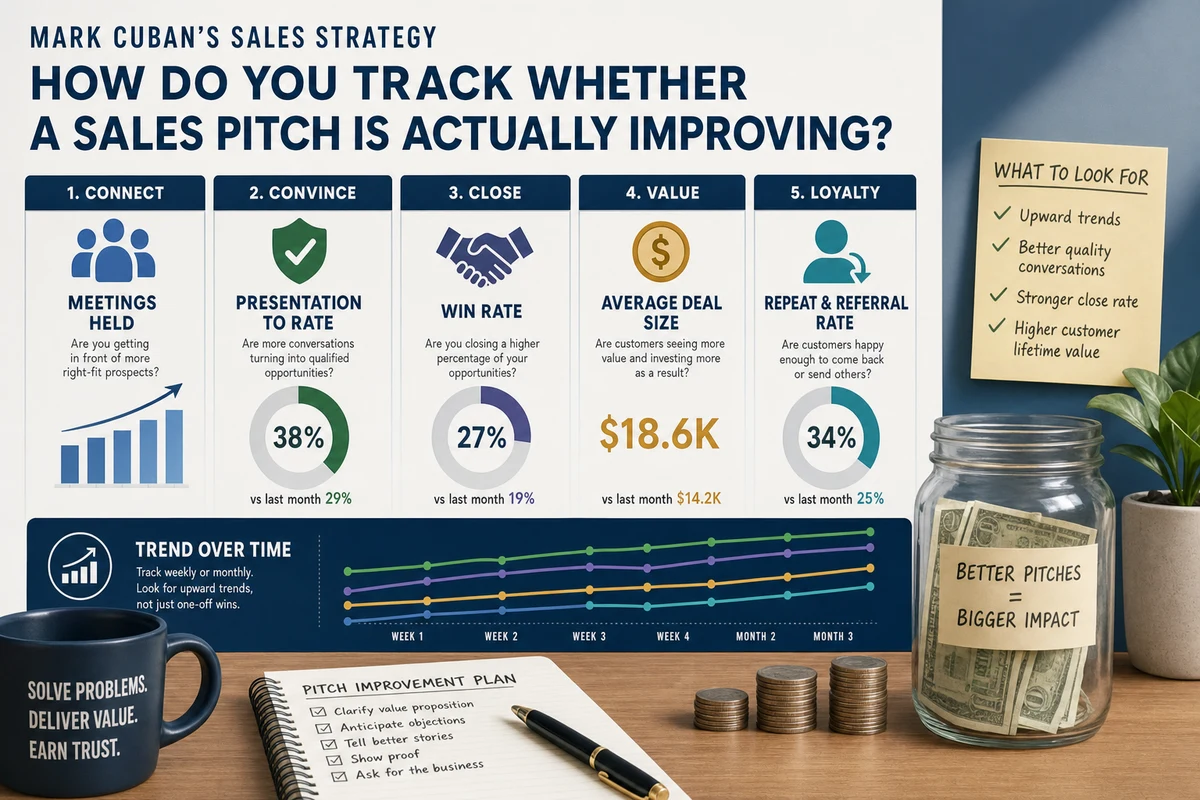
Track movement through a defined sales funnel rather than relying on impressions. At minimum, record qualified opportunities, pitches or proposals, purchases, revenue, gross profit, and the reason each opportunity was won or lost. A qualified opportunity is someone who fits your target customer criteria and has a plausible need, authority, and buying timeline.
Suppose the original pitch produces 8 customers from 50 qualified opportunities. The conversion rate is 8 ÷ 50 × 100, or 16%. A revised pitch produces 12 customers from the next 50 comparable opportunities, for a 24% conversion rate.
If each sale generates $1,500 in revenue and $900 in gross profit before fixed overhead, the second group produces four additional sales and an estimated $3,600 in additional gross profit: 4 × $900. That figure is an example, not a forecast. It assumes the lead quality, price, delivery cost, follow-up period, and sales capacity remained comparable.
Do not celebrate conversion rate in isolation. A steep discount may increase conversions while reducing profit. A looser qualification rule may make the pipeline look larger while lowering the close rate. Track average selling price, gross profit per sale, refund or cancellation rate, sales cycle length, and acquisition cost alongside conversion.
Accurate profit measurement also requires consistent expense records. A process for automating expense monitoring can help identify payment-processing charges, advertising costs, contractor expenses, refunds, and delivery costs that revenue-only sales reports overlook.
For online sales, define events for meaningful actions such as submitting a qualified inquiry, scheduling a consultation, or completing a purchase. Google’s Analytics guidance for creating and managing events explains how event measurement works. Apply appropriate privacy, consent, and data-retention rules for the jurisdictions where you operate.
Small samples are noisy. Moving from one sale to two is a 100% increase, but it is not enough evidence to declare a message superior. As a practical operating rule, run the test across at least one normal sales cycle and document unusual changes in seasonality, traffic source, pricing, or salesperson. Businesses making high-value, low-volume sales may need to rely more heavily on qualitative call reviews because statistical certainty could take months.
Action: Create a weekly scorecard showing qualified opportunities, proposals, wins, conversion rate, average price, gross profit, sales-cycle length, and the top three loss reasons.
What should you do over the next seven days?
The highest-priority next step is not rewriting every piece of marketing. First verify that you can describe one costly customer problem and one credible benefit in the customer’s own language. Then improve the message in small, measurable rounds.
Seven-day sales improvement plan
- Days 1–2: Review customer evidence
- ∼ Read recent sales notes, support messages, reviews, and cancellations
- ∼ Identify repeated problems, consequences, alternatives, and desired outcomes
- Day 3: Interview customers and lost prospects
- ∼ Ask about recent behavior rather than hypothetical interest
- ∼ Record exact phrases and unresolved objections
- Day 4: Write and test the value proposition
- ∼ Name the customer, problem, benefit, mechanism, and alternative
- ∼ Remove claims you cannot substantiate
- Day 5: Build the objection map
- ∼ Separate concerns about value, cash flow, authority, risk, and timing
- ∼ Prepare questions and evidence instead of automatic discounts
- Days 6–7: Deliver and measure the revised pitch
- ∼ Use the same audience and offer where possible
- ∼ Record conversion, price, profit, cycle length, and loss reasons
After the first week, choose one bottleneck. If prospects do not engage, refine the problem and target customer. If they engage but do not believe the benefit, strengthen the demonstration or evidence. If they believe the benefit but delay, clarify implementation, authority, budget, and the next decision. If conversions rise while profit falls, revisit pricing and discounting.
The practical lesson from Mark Cuban’s sales strategy is not to become louder or more aggressive. It is to become more useful in the buying conversation. Diagnose the problem accurately, express the benefit specifically, support it honestly, and let measured customer behavior show whether the message works.
Prioritized next step: Before changing your website or buying more leads, interview five qualified customers and use their answers to rewrite one sentence: who you help, what problem you solve, and what credible result your offer creates.