
Business books will not magically deposit money into your checking account. But the right books, read the right way, can absolutely make you more valuable. They give you better language for selling your work, sharper frameworks for making decisions, and proven playbooks for negotiating, marketing, leading, building systems, and spotting opportunities before everyone else.
That is the real income boost: not "I read 40 pages, therefore I get rich," but "I read one strong idea, apply it to a high-value problem, and turn the result into leverage." That is how a $20 book can become a raise conversation, a better offer, a cleaner sales page, a smarter business process, or a side income idea with teeth.
Why business books can actually raise your income
Income follows value. Value follows skill. Skill follows repeated exposure, practice, feedback, and application. Business books are one of the cheapest ways to borrow decades of experience from people who have already solved problems you are still wrestling with.
Think of every useful business book as a menu of income levers:
- Sales: close more deals, handle objections, and make stronger proposals.
- Marketing: get attention, clarify your message, and create demand.
- Negotiation: ask for more money with evidence instead of anxiety.
- Leadership: manage teams, meetings, conflict, and execution better.
- Productivity: protect deep work and ship more valuable output.
- Strategy: choose better opportunities instead of chasing every shiny idea.
- Finance: make better capital, pricing, investing, and risk decisions.
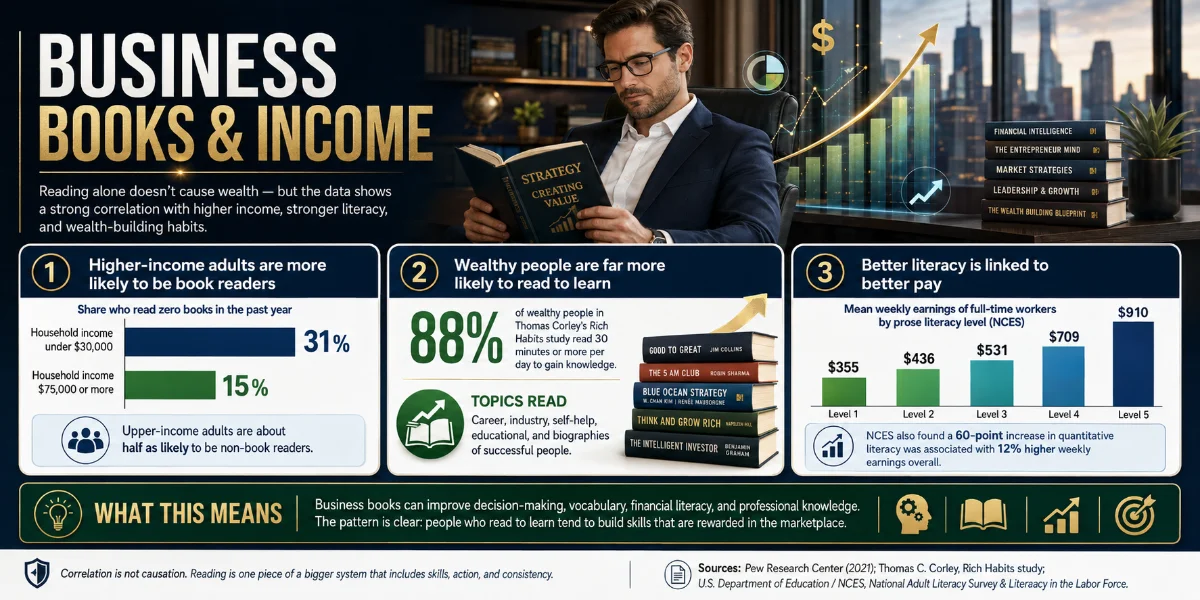
The stats: learning still pays
The hype around business books gets silly fast, so let's anchor this in stronger evidence. A popular Sales & Marketing Executives International claim says businesspeople who read at least seven business books per year earn 2.3 times more than those who read one. Treat that as directional, not a guarantee. The point is not that books alone cause income. The point is that people who keep learning usually keep getting more useful.
Here is the sturdier case:
- The Bureau of Labor Statistics reported that in 2024, workers with a bachelor's degree had median weekly earnings of $1,543, compared with $930 for workers with only a high school diploma. Formal education is not the same thing as reading, but it shows the market rewards accumulated skill and knowledge.
- The World Economic Forum says employers expect 39% of workers' core skills to change by 2030. Translation: the people who keep learning have a better shot at staying relevant while everyone else waits for the job market to make the first move.
- Pew Research Center found that 54% of workers said ongoing training and skill development would be essential throughout their work life, and another 33% said it would be important. That is 87% of workers saying the same quiet truth: standing still is expensive.
- High-value business skills have real market prices. The BLS reports median annual pay of $138,060 for sales managers and $159,660 for marketing managers in May 2024. Those roles are built on skills you can start studying today: persuasion, positioning, communication, analysis, and execution.
- On the freelance side, Upwork reported that generative AI modeling skills commanded up to 22% higher hourly rates than traditional AI and machine learning roles in its 2025 skills analysis. Skill stacking is not theory. The market prices it every day.
The reading-to-income flywheel
Most people read passively. They highlight 40 things, feel productive, and change nothing. The income-focused reader does something different: they read to create one useful output.
Choose a money lever
Pick the income problem you want the book to help solve. Do you need a raise? More clients? Better sales calls? A cleaner offer? More productive workdays? A business idea with actual demand? If the book is not connected to a money lever, it becomes entertainment. Useful entertainment, but still entertainment.
Extract one tactic
Do not try to implement the whole book. Choose one tactic that can change behavior this week. If you are reading a negotiation book, write a raise script. If you are reading a marketing book, rewrite your LinkedIn headline or offer page. If you are reading a productivity book, redesign one recurring work block.
Apply it to real work
The money is in the application. A sales framework is worth nothing until you use it on a real client conversation. A leadership principle is worth nothing until it improves a messy meeting. A productivity system is worth nothing until it protects time for work that makes you more valuable.
Track proof
Keep score. Did the tactic save two hours per week? Increase close rates? Reduce mistakes? Improve response rates? Create a client win? Make your manager's life easier? Proof turns "I read a lot" into "I created a result."
Turn proof into an ask
Income usually changes when you make a move: negotiate, pitch, apply, raise prices, package a service, ask for a referral, or launch an offer. Books give you ideas. Proof gives you confidence. The ask turns both into money.
Best business book categories for boosting income

If you are reading specifically to earn more, organize your list by earning power instead of whatever is trending on social media.
1. Negotiation books
These help with salary offers, raises, client contracts, vendor pricing, and uncomfortable conversations. Start here if you are underpaid, undercharging, or avoiding direct money talks.
2. Sales books
Sales is not just for salespeople. If you need someone to approve a project, buy your service, fund your idea, hire you, promote you, or trust your recommendation, you are selling. Learn the skill and your income ceiling gets much higher.
3. Marketing and positioning books
Great work still needs visibility. Marketing books teach you how to explain value so people understand why they should care now. This is gold for freelancers, creators, entrepreneurs, and professionals who want better opportunities to find them.
4. Productivity and deep work books
Income often rises when your output gets more valuable, not merely when your calendar gets fuller. Books on focus, systems, and execution help you protect the work that actually moves your career or business forward.
5. Leadership and communication books
The higher you go, the less your income depends only on individual tasks. It starts depending on judgment, communication, trust, influence, and the ability to move people toward a result.
6. AI, automation, and leverage books
Tools change fast, but the meta-skill is stable: learn how to produce more value with fewer bottlenecks. If you can automate repetitive work, create content faster, analyze information better, or build useful systems, you become harder to ignore.
The 90-Day Business Book Income Plan
- Pick one income target: raise, promotion, client work, freelance offer, better sales, or better systems.
- Choose 3 books, one per month, tied directly to that target.
- Read 20 minutes a day or listen during commutes, walks, chores, or gym time.
- After every chapter, write one action you can test in real life.
- Run one experiment per week and track the result.
- At the end of 90 days, turn the proof into a raise ask, new offer, stronger portfolio, or better pitch.
How to read business books faster and get more from them
The goal is not to finish the book. The goal is to extract the highest-return idea and do something with it. Try this system:
- Preview first: scan the table of contents and pick the chapters most relevant to your income goal.
- Read with a question: "How can this help me earn more, save time, sell better, or make better decisions?"
- Keep a one-page note: problem, useful idea, action step, result to measure.
- Ignore filler: not every story, case study, or anecdote deserves equal attention.
- Apply before continuing: one implemented idea beats ten abandoned highlights.
- Revisit quarterly: the same book can become more valuable after you have new problems.
What to read first if you want more money
Start with the skill closest to your next income move. If you are employed, read negotiation, communication, and leadership. If you freelance, read sales, offers, and positioning. If you own a business, read marketing, systems, pricing, and strategy. If you are starting from scratch, read habit-building and one practical high-income skill.
We built a curated list of the best business, finance, productivity, strategy, and money books so you do not have to wander through endless recommendations. Use it to choose your next book based on the income lever you want to pull.
Want the shortcut? Use High-Income Skill Accelerator
Reading is powerful, but random reading is slow. That is exactly why we built High-Income Skill Accelerator: a focused course and guide library designed around the skills most directly tied to earning power.
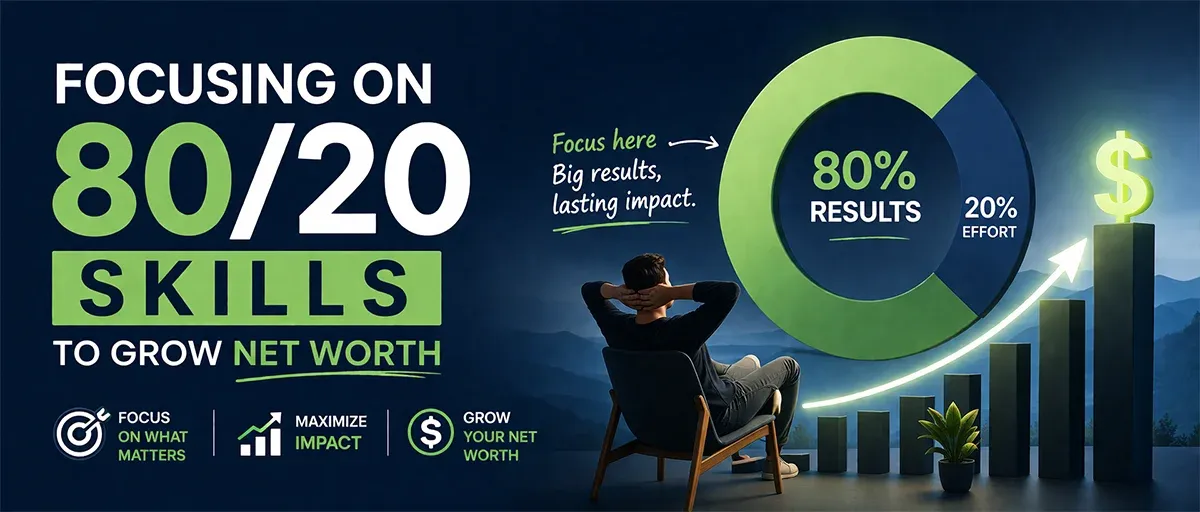
Inside, you get a practical skill stack covering sales, copywriting, marketing, technical leverage, content, and AI-powered systems. You also unlock 82 exclusive 80/20 book guides, so instead of spending weeks trying to figure out what matters, you can jump straight to the highest-value ideas and the actions that make them useful.
Wrap up
Business books boost your income when they stop being content and start becoming capability. Pick the right book, extract one move, apply it to real work, measure the result, and use that proof to ask for more money or create a better offer.
Read like your future income is listening. Because, in a very real way, it is.