
Being house poor means your mortgage and other homeownership costs consume so much cash flow that saving, paying for repairs, and covering ordinary life become difficult. To avoid becoming house poor, calculate the home’s complete monthly cost, compare it with take-home pay—not gross income—and test whether the budget survives an income drop, cost increase, or major repair.
A lender’s approval tells you how much it may be willing to lend under its underwriting rules. It does not tell you whether the payment leaves enough money for retirement, childcare, medical costs, travel, career changes, or financial emergencies. Your practical home-buying limit is the lower of the lender’s approval and the amount your household can carry without sacrificing those priorities.
What does being house poor look like?
A house-poor household is not necessarily behind on its mortgage. Many homeowners make every payment on time while carrying credit card balances, postponing maintenance, reducing retirement contributions, or depending on bonuses and tax refunds for predictable expenses.
The problem is the size and inflexibility of housing costs. You can cancel a subscription quickly, but meaningfully reducing housing expenses may require refinancing, finding a legal tenant, or selling and moving. Each option takes time, may require approval, and can involve substantial transaction costs.
Warning signs that a home is consuming too much of your budget include:
- Using credit cards for groceries, utilities, insurance, or routine repairs.
- Saving little or nothing after the monthly housing costs are paid.
- Needing overtime, bonuses, or two uninterrupted incomes to cover normal expenses.
- Deferring maintenance because the repair account has insufficient cash.
- Having little liquidity because the down payment and closing costs exhausted your reserves.
- Feeling financially unable to change jobs, take parental leave, or replace a vehicle.
- Choosing the minimum insurance coverage solely to make the monthly budget work.
Do not judge affordability by whether you can make the payment in an average month. Look at the last three months of bank and credit card activity and identify what housing displaced. If you stopped saving, accumulated revolving debt, or delayed routine care after moving, the payment may be technically current but financially unsustainable. If reviewing transactions manually is inconsistent, use an automated expense-monitoring process to surface recurring shortfalls.
This is one reason the advertised monthly payment can be misleading. The broader problem is explained in the monthly payment affordability trap: fitting a payment into one month does not establish that the underlying purchase fits your long-term finances.
Action: Add up three months of housing costs, savings, and consumer borrowing. If normal home expenses repeatedly force you to borrow or reduce planned savings, set a specific cost-reduction target rather than treating each shortfall as an isolated event.
Calculate the complete monthly cost of owning a home

Principal and interest are only the starting point. A useful house-poor calculation includes every recurring cost required to occupy, insure, and preserve the property.
Build the total from these components:
- Principal and interest: The scheduled loan payment. An adjustable-rate mortgage can change after its initial fixed-rate period.
- Property taxes: Use the expected tax after purchase, not automatically the seller’s current bill. Reassessment practices and exemptions vary by jurisdiction.
- Homeowners insurance: Include the premium and understand the deductible. Standard policies may exclude hazards such as flooding, depending on the policy and location.
- Mortgage insurance: Depending on the loan program, loan-to-value ratio, and down payment, this may be required in addition to homeowners insurance.
- Association costs: Include condominium or homeowners association dues and review the possibility of increases or special assessments.
- Utilities and services: Estimate electricity, heating fuel, water, sewer, trash, internet, pest control, landscaping, and snow removal where applicable.
- Maintenance and repairs: Set aside money for appliances, plumbing, roofing, heating and cooling equipment, exterior work, and other components that wear out.
Review the lender’s official Loan Estimate rather than relying on an advertisement, calculator, or verbal quote. The Consumer Financial Protection Bureau explains the document, mortgage insurance, estimated taxes, insurance, and other costs buyers should compare in its guide to reviewing a Loan Estimate. Ask the lender which figures are locked, which are estimates, and which could change before closing.
Insurance also requires a coverage review, not just a premium comparison. Examine deductibles, exclusions, replacement-cost provisions, liability limits, and any separate hazard coverage the property may need. This guide to evaluating insurance coverage explains how to focus on losses you could not comfortably self-fund.
Action: Put every component into one worksheet and convert annual or quarterly bills into monthly amounts. Do not call the home affordable until the all-in figure—not just the mortgage payment—fits your budget.
How much house can you afford without becoming house poor?

There is no universal mortgage-to-income percentage that makes a home affordable. A household with childcare, student loans, irregular earnings, or upcoming medical costs may need a much lower housing expense than a debt-free household with stable income. Location also changes property taxes, insurance, commuting costs, and utilities.
Lenders commonly consider debt-to-income ratio, or DTI, which divides required monthly debt payments by gross monthly income. The Consumer Financial Protection Bureau’s DTI explanation describes this underwriting measure.
DTI is useful for evaluating debt obligations, but it is not a complete household budget. Gross income is measured before taxes and payroll deductions, while DTI generally does not capture food, utilities, childcare, maintenance, retirement saving, and many insurance costs. Loan approval therefore should be treated as a financing boundary, not a spending recommendation.
Calculate baseline cash flow
Start with average monthly take-home pay after taxes, insurance premiums, and payroll deductions. If income varies, use a conservative average from at least the previous 12 months and exclude unusual windfalls. Self-employed households should separately reserve money for taxes and business expenses.
Subtract non-housing essentials, required debt payments, insurance, family expenses, and planned savings. Use actual transaction history where possible rather than an idealized budget.
Protect savings and financial resilience
Decide how much cash flow must remain after buying. Include retirement contributions, emergency savings, vehicle and medical sinking funds, and a home-maintenance reserve. A sinking fund is money accumulated gradually for a predictable but irregular expense.
For example, suppose a household receives $8,500 in monthly take-home pay. Non-housing needs and debt total $2,600, planned saving is $1,200, and the household chooses a $700 monthly safety margin. Its complete housing-cost ceiling is:
$8,500 − $2,600 − $1,200 − $700 = $4,000 per month.
That 4,000 dollars must cover principal, interest, taxes, insurance, fees, utilities, and maintenance. If property-specific estimates put non-mortgage costs at 1,400 dollars, only 2,600 dollars remains for principal and interest.
Emergency savings should remain accessible after closing because a credit line can be reduced, expensive, or unavailable precisely when income falls. The tradeoffs are covered in why credit is not a complete emergency-fund substitute. Keeping too much beyond the emergency and near-term repair reserves has its own opportunity cost, so also review how to separate useful cash reserves from excess idle cash.
Convert the ceiling into a purchase price
Ask a lender for estimates at several purchase prices and down payments. Add independent estimates for insurance, utilities, association costs, and maintenance, then work backward until the complete cost remains below your ceiling. Also compare closing cash requirements so a lower payment does not come at the cost of empty reserves.
Action: Write down your maximum all-in monthly housing cost before viewing homes. Give that number to your lender and agent so an attractive property does not redefine affordability during negotiations.
How should you estimate maintenance and major repairs?

Home maintenance is uneven. A property may require little spending for several months and then need a water heater, sewer repair, or roof replacement. Treating a quiet year as the normal cost can make ownership appear cheaper than it is.
Some buyers use a percentage of the property’s value as a preliminary maintenance allowance, but that shortcut is not a prediction or guarantee. Property age, condition, climate, labor costs, construction type, and association coverage can make actual spending much lower or higher. Property-specific inspections, service records, association documents, and contractor quotes should replace the shortcut before an offer becomes final.
For illustration, a household evaluating a $450,000 property might test a 1.5% annual reserve as one budget scenario. That assumption produces $6,750 per year:
$450,000 × 0.015 = $6,750, or about $563 per month.
The household would not expect to spend $563 every month. It would transfer that amount to a dedicated account while it gathers property-specific estimates, then raise or lower the transfer based on the five-year repair schedule.
Create that property-specific schedule using:
- The age and condition of the roof, HVAC system, water heater, windows, and appliances.
- Known plumbing, sewer, foundation, drainage, electrical, moisture, or pest concerns.
- Recurring exterior work, landscaping, snow removal, pool care, and private-road expenses.
- Condominium reserve reports, association budgets, meeting minutes, and pending assessments.
- Your insurance deductible and the cost of excluded or uncovered damage.
For example, local quotes may put roof work at 15,000 dollars in five years and HVAC replacement at 8,000 dollars in three years. Dividing by the remaining months produces targets of 250 dollars and about 222 dollars. Use quotes instead of generic assumptions for aging components.
A general home inspection can identify visible conditions, but it cannot guarantee how long a component will last. Obtain specialist evaluations when the inspection flags structural, sewer, roof, electrical, environmental, or water-intrusion concerns.
Do not assume tax deductions will reimburse repair costs or make an unaffordable purchase manageable. U.S. federal mortgage-interest treatment depends on current law, itemization, loan use, and personal circumstances. Review the current IRS Publication 936 on home mortgage interest and consult a qualified tax professional if tax treatment materially affects your decision.
Action: Price the three largest likely projects before closing. Annualize those estimates, add smaller routine maintenance, and keep the resulting reserve separate from closing cash and ordinary checking.
Use a stress test to find hidden affordability risks

A baseline budget asks whether the home works when events follow the plan. A stress test asks whether ownership remains manageable when they do not. The scenarios should reflect plausible risks in your household rather than extreme events chosen to make every purchase fail.
Run at least these four scenarios:
- Income reduction: As a test assumption, reduce take-home income by 20% for six months. For a two-income household, also test losing the lower income entirely.
- Housing-cost increase: Test a 15% increase in estimated property tax and insurance costs, then add a property-specific increase for utilities or association dues.
- Major repair: Model a $10,000 to $20,000 non-cosmetic project during the first two years, or substitute the largest project identified by the inspection and quotes.
- Competing priority: Add childcare, eldercare, a vehicle replacement, medical costs, or another expense reasonably likely within five years.
These figures are deliberately conservative test assumptions, not forecasts, typical costs, or recommended thresholds. Replace them with risks and estimates that match the property, employment situation, insurance deductibles, and household plans.
Consider a hypothetical household with 8,500 dollars in take-home pay and proposed monthly housing costs of 2,750 dollars for principal and interest, 650 dollars for taxes, 250 dollars for insurance, 100 dollars for association fees, 400 dollars for utilities, and 750 dollars for maintenance. The complete modeled cost is:
$2,750 + $650 + $250 + $100 + $400 + $750 = $4,900 per month.
That equals about 58% of the household’s take-home pay. If its non-housing costs total $2,600 and it wants to save $1,000 monthly, nothing remains as a safety margin. Under the modeled 20% income reduction, take-home pay falls to $6,800 and the household faces a $1,700 monthly deficit before any major repair.
Now model a less expensive property with an all-in monthly cost of $3,750. With the same non-housing expenses and savings goal, the household keeps a $1,150 monthly margin. Under the same income-reduction scenario, it still faces pressure, but the deficit is smaller and existing reserves last longer.
The cheaper property is not automatically safe; the example shows how lower fixed costs preserve options. When comparing whether to finance a purchase or build more cash first, use the CFPB guidance on preparing for a major purchase to review credit and financing readiness.
Action: Resize or reject a purchase if one plausible setback immediately requires high-interest debt. A useful stress test should leave time and options for adjustment, not merely postpone a shortfall by one month.
Which tradeoffs reduce the risk of becoming house poor?

Improving affordability does not always require abandoning homeownership. It may require changing the property, location, down payment, financing, or purchase date. Compare each option by its total effect on cash flow and reserves.
- Buy less space: A smaller property can reduce the purchase price, utilities, furnishing costs, and maintenance workload.
- Choose condition over size: A smaller home with newer major systems may produce steadier cash flow than a larger property needing immediate work.
- Use a larger down payment selectively: More money down may reduce the loan balance or mortgage-insurance cost, but it can increase risk if it empties emergency and repair reserves.
- Delay the purchase: Additional time can strengthen cash reserves, improve credit, or reduce other debt. Home prices and borrowing costs may move in either direction.
- Compare total location costs: A cheaper home farther away may add commuting, vehicle, childcare, toll, or time costs.
- Count rental income cautiously: A legal rental unit may help, but vacancies, repairs, taxes, insurance requirements, and local landlord rules reduce the benefit.
Be cautious when affordability depends on appreciation, refinancing, future raises, or uninterrupted rental income. Those outcomes are uncertain. The purchase should work under its current terms without requiring a favorable future event.
After closing, automatic transfers can protect emergency, repair, and long-term savings before discretionary spending absorbs the money. The systems in seven financial tasks worth automating can help, although every automated account still needs regular monitoring.
Action: Identify one feature you can reduce—purchase price, square footage, location premium, renovation scope, or timing—and calculate how much monthly flexibility the change creates. Favor the option that improves both cash flow and post-closing reserves.
What should you do before making an offer?
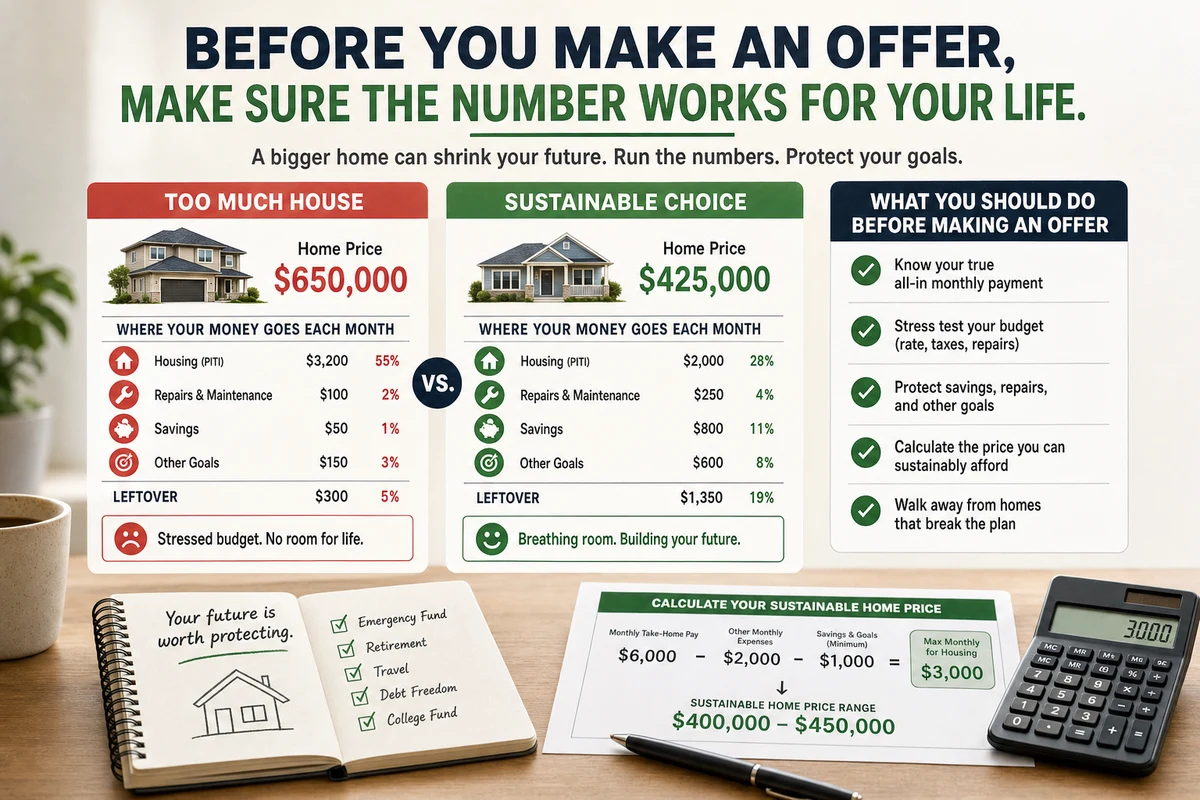
Set your affordability boundary before emotion and competition enter the decision. Use conservative assumptions, document them, and replace estimates as the lender, insurer, inspector, tax authority, or association provides property-specific information.
- Calculate the complete monthly housing cost, not only principal and interest.
- Protect retirement saving, emergency reserves, and known priorities before setting the limit.
- Keep down-payment and closing cash separate from the money needed after move-in.
- Review the Loan Estimate, insurance quote, expected taxes, utilities, and association records.
- Build a five-year repair schedule using inspection findings and component ages.
- Run income-loss, housing-cost increase, major-repair, and life-change stress tests.
- Lower the target price if a realistic adverse scenario creates immediate consumer debt.
If the decision is close, prioritize the steps in that order: verify the all-in cost, preserve post-closing cash, stress-test the budget, and only then compare properties. A fee-only financial planner can help with cash-flow tradeoffs, while a licensed lender, insurance professional, tax professional, attorney, or property specialist may be appropriate when the decision depends on financing terms, coverage, taxes, contracts, or building conditions.
A home can contribute to stability and long-term wealth only if the household can afford to own it through ordinary setbacks. The 80/20 personal finance framework can help you weigh this purchase against other high-impact financial priorities.
Your next step: Calculate one all-in monthly housing ceiling today. Use it as a firm boundary for every property, and lower the purchase target rather than removing savings or assuming future income will close the gap.