
Credit card balance interest can make an 8,000 dollars purchase balance cost thousands more than its original price. By using the APR, average daily balance, and payment amount from your statement, you can estimate next month’s interest, choose a realistic payoff date, and determine whether a balance transfer or consolidation loan would actually save money.
The fastest way to reduce the cost is usually to stop new charges, automate at least the minimum, and commit to a fixed payment that does not decline with the statement minimum. Then compare refinancing offers by total dollars repaid—not by the advertised monthly payment alone.
How is credit card balance interest calculated?
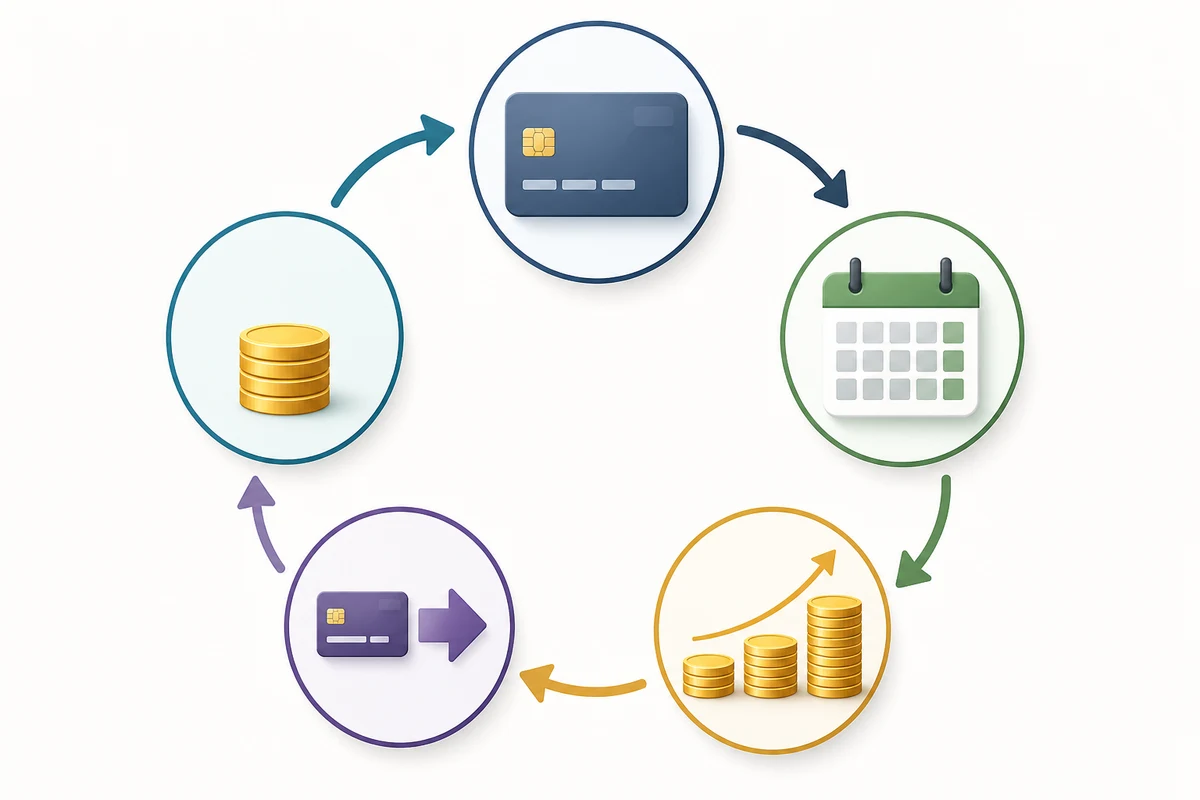
A credit card’s annual percentage rate, or APR, expresses the yearly cost of borrowing. Issuers commonly convert that APR into a daily periodic rate and apply it to each day’s balance. The specific method, transaction treatment, and compounding rules appear in the card agreement.
Assume a card has an $8,000 average daily balance, a 24.99% APR, and a 30-day billing cycle. Its daily periodic rate is approximately 0.06847%. Estimated interest for the cycle is:
$8,000 × 0.2499 ÷ 365 × 30 = $164.32
If you then pay $200, only about $35.68 reduces principal—the amount borrowed before interest. The remaining $164.32 covers that cycle’s estimated borrowing cost. If the next cycle looks similar, the balance will barely move even though you are making payments.
This formula is an estimate, not a replica of your statement. Billing-cycle length, transaction and payment dates, fees, rounding, compounding, and separate APR categories can change the actual charge. Cash advances may have a different APR and may begin accruing interest without a grace period. The CFPB explanation of credit card interest calculations describes common issuer methods.
Action: On your latest statement, record the average daily balance, each APR, and the interest charged. If the amount is higher than your estimate, look for cash advances, fees, an expired promotion, a penalty APR, or transactions subject to a different rate.
Why does the average daily balance make payment timing matter?

The average daily balance is generally the sum of each day’s balance divided by the number of days in the billing cycle. A payment made early lowers more of those daily balances than the same payment made near the end. New purchases have the opposite effect because they increase the balance for every remaining day after they post.
Consider an 8,000 dollars balance over a 30-day cycle. If a 200 dollars payment posts after the first day, the approximate average daily balance becomes:
($8,000 × 1 day + $7,800 × 29 days) ÷ 30 = $7,806.67
If the payment posts after day 28, the approximate average is:
($8,000 × 28 days + $7,800 × 2 days) ÷ 30 = $7,986.67
At 24.99 percent, that 180 dollars difference in average daily balance represents about 3.70 dollars of interest for the cycle. The saving is modest, but it repeats when payments consistently arrive earlier. The larger benefit is that principal stops generating future interest sooner.
Payment timing does not replace the due date. A useful system is to automate the required minimum as protection against an accidental late payment, then send extra payments after each paycheck. Confirm that the checking account funding the autopay has enough cash to avoid an overdraft or returned payment.
If you carry a balance, check how that affects interest on new purchases. A grace period is the time during which qualifying purchases may avoid interest if the required balance is paid under the account terms. Grace periods and how they are restored vary by agreement; the CFPB guide to credit card grace periods explains the general rule.
If the statement’s fields are unclear, use this guide to understanding a credit card statement safely. Avoid uploading your full account number, address, or other identifying information to an AI tool.
Action: Keep due-date autopay active, but send planned extra money as soon as it is available. Pause purchases on the payoff card if new charges are preventing the statement balance from falling.
Why do minimum payments keep a credit card balance around?

A minimum payment is the amount required to keep the account contractually current. It is not a recommended payoff amount. Depending on the issuer, it may be a percentage of the balance, a percentage of principal plus interest and fees, or a fixed floor when the calculated amount is small. Your statement and card agreement control.
Suppose the minimum is approximately the month’s interest plus 1 percent of principal. On an 8,000 dollars balance at 24.99 percent, the first payment might be near 244 dollars: roughly 164 dollars of interest plus 80 dollars of principal. After the balance falls, the principal portion and required payment can also fall.
That declining payment creates the long payoff. If you follow only the newly calculated minimum, you reduce your payment as the debt shrinks. Keeping the original payment fixed sends an increasing number of dollars to principal each month.
The following estimates use an $8,000 starting balance, a constant 24.99% APR divided into monthly periods, no fees, and no new purchases:
| Payment approach | Approximate payoff | Approximate interest | Primary tradeoff |
|---|---|---|---|
| Recalculated minimum | Potentially many years | Depends heavily on the issuer’s formula | The required payment may decline over time |
| Fixed $300 monthly | About 40 months | About $3,800 | Limited room for an APR increase |
| Fixed $500 monthly | About 20 months | About $1,800–$1,900 | Requires dependable monthly cash flow |
These are planning estimates rather than card disclosures. Daily interest, payment dates, rounding, variable rates, and the final partial payment will produce different results. Your statement may also show a minimum-payment warning with an issuer-calculated payoff estimate.
A payment must be sustainable. Committing $500 and then borrowing $300 for groceries is not a $500 payoff strategy. Start with an amount that works in a conservative month, then apply windfalls or expense reductions as optional extra principal. The guide to why minimum credit card payments prolong debt explores this declining-payment problem in more detail.
Action: Automate the minimum, choose a fixed total payment above it, and schedule the difference separately. Recalculate the payoff date whenever the APR, balance, or affordable payment changes.
Should you use the debt avalanche or debt snowball?
Both payoff methods require you to make every minimum payment and direct all extra money to one target. The difference is how they choose that debt:
- Debt avalanche: Target the highest APR first. With the same payments and no new charges, this generally minimizes interest.
- Debt snowball: Target the smallest balance first. This can eliminate an account sooner and reduce the number of monthly bills.
- Hybrid method: Clear one unusually small balance, then switch to the highest APR.
Imagine Card A has a $1,500 balance at 18%, while Card B has a $6,500 balance at 29.99%. The snowball targets Card A because it is smaller. The avalanche targets Card B because every dollar left there incurs the higher rate.
The avalanche is the mathematical choice for minimizing interest under consistent assumptions. The snowball may be more workable when quickly removing one payment helps cash flow or plan adherence. A hybrid can make sense when a small balance can be eliminated within one or two months without leaving a much higher-rate balance untouched for long.
Neither method can outpace continuous new borrowing. Before directing every available dollar to debt, retain enough cash for essential bills and a modest emergency buffer. Otherwise, a car repair, insurance deductible, or urgent trip may return to the card. See why credit is not a complete emergency fund for the tradeoffs of relying on an available credit limit.
Action: List every balance, APR, minimum, and due date. Pay all minimums, choose one target, and redirect that account’s full former payment to the next debt when it reaches zero.
When will a balance transfer save money?

A balance transfer moves debt to another credit card, often at a temporary promotional APR. It can reduce interest, but the correct comparison includes the transfer fee, promotional period, post-promotion APR, credit limit, and payment needed to clear the balance before the offer ends.
Assume you transfer $8,000 to a card offering 0% for 15 months with a 3% transfer fee. These are illustrative offer terms, not a market average. The fee is $240, making the amount to repay approximately $8,240:
$8,240 ÷ 15 = $549.33 per month
If your budget supports only $400, you would still owe about $2,240 when the promotion ends, assuming no other charges or interest. That balance could then accrue interest at the standard transfer APR stated in the offer. A transfer may still reduce costs, but it has not solved the entire payoff.
A balance-transfer fee may be calculated as a percentage of the amount transferred, sometimes subject to a minimum fee. Review the specific disclosure and the CFPB explanation of balance-transfer fees before calculating savings.
Also verify whether the fee uses part of the credit limit, the deadline for completing the transfer, the effect of a late payment, and how payments are allocated when the card contains multiple balance types. Avoid purchases on the transfer card unless you understand the purchase APR and grace-period consequences. A 0 percent introductory APR is not necessarily the same as a deferred-interest offer.
Action: Add the transfer fee to the balance and divide the total by the number of promotional months. If that payment is unaffordable, estimate the leftover balance and its interest at the post-promotion APR before applying.
When can a consolidation loan help—or make debt worse?

A debt-consolidation loan replaces one or more revolving balances with an installment loan. A fixed rate, fixed payment, and defined payoff date can make progress easier to measure. However, a lower monthly payment does not automatically reduce cost; it may simply extend repayment over more years.
For illustration, compare an $8,000 card balance at 24.99% with a three-year personal loan at 12%. With no fees, the loan payment would be about $266 per month, and total interest would be approximately $1,570. That is less than the roughly $3,800 estimated for paying $300 monthly on the card.
Real offers may include an origination fee. A hypothetical 5 percent fee is 400 dollars on an 8,000 dollars loan. If the lender deducts it from the proceeds, an 8,000 dollars loan may deliver only 7,600 dollars—too little to repay the card. Compare APR, total payments, and net proceeds rather than looking only at the advertised interest rate.
Consolidation can fail if the paid-off cards are refilled. You would then have both an installment payment and new revolving debt. It can also increase risk if unsecured card debt is replaced by a loan secured by a car or home, because default could put the pledged asset at risk.
Debt settlement is different from consolidation. Companies that instruct customers to stop paying creditors may expose them to delinquency, collection activity, fees, lawsuits, credit damage, and possible tax consequences if debt is forgiven. Review the FTC guidance on debt relief and getting out of debt and consider professional advice when legal or tax consequences depend on your circumstances.
The detailed guide to evaluating a debt-consolidation loan covers additional risks. If refinancing could improve an existing loan rather than card debt, the guide to comparing refinancing offers explains how term length and fees affect the result.
Action: Compare total dollars repaid, APR, fees, term, net proceeds, collateral, and prepayment rules. Reject an offer that lowers the payment only by extending expensive debt farther into the future.
What should you do first to reduce credit card balance interest?
Stabilize the account
Make at least the minimum by every due date, preferably through autopay from a monitored checking account. Stop discretionary purchases on the payoff card, move essential recurring charges if necessary, and ask the issuer directly whether a lower APR or hardship arrangement is available. Approval and terms vary, but making the request does not require paying a debt-relief company.
Set a fixed payment and target date
Use the current balance, APR, and an affordable fixed payment to estimate the payoff timeline. Leave room for essential expenses and a small cash reserve. Check progress monthly, but do not reduce the fixed payment merely because the required minimum declines.
Compare refinancing by total cost
For a balance transfer, include the fee, promotional deadline, and post-promotion APR. For a consolidation loan, include origination costs, net proceeds, total payments, term, and collateral. Keep making the existing payment until the old creditor confirms that transferred funds arrived.
Confirm the final payoff
After the visible balance reaches zero, check the next statement for residual or trailing interest—interest that accrued between the previous statement date and the date your payment posted. Ask the issuer for a current payoff amount when necessary, then verify that no subscriptions or automatic charges remain.
If minimums are already unaffordable, contact the issuer before missing payments. A nonprofit credit counselor may be able to review budgeting and debt-management options. Consult an attorney or qualified tax professional when the situation involves lawsuits, insolvency, bankruptcy, forgiven debt, or assets that could be placed at risk.
Your prioritized next step: Open your latest statement and write down the balance, purchase APR, interest charge, minimum payment, and due date. Automate the minimum and set a sustainable fixed payment above it today. Compare avalanche, snowball, balance-transfer, or consolidation options only after that baseline payment is reliable.