What Is Compound Interest?
Here's the simplest way to think about it: you earn interest on your interest. Every year, your interest gets added to your balance — and the following year you earn interest on that larger number. The longer this goes on, the faster your money grows.
A simple example — $1,000 at 10% per year
| Year | Balance | Interest earned this year |
|---|---|---|
| Year 1 | $1,100 | $100 |
| Year 2 | $1,210 | $110 |
| Year 3 | $1,331 | $121 |
| Year 5 | $1,611 | $146 |
| Year 10 | $2,594 | $236 |
| Year 20 | $6,727 | $611 |
| Year 30 | $17,449 | $1,586 |
Notice how the interest earned each year keeps growing — from $100 in year 1 to $1,586 in year 30. That's compounding at work. You put in $1,000 and did nothing else. After 30 years you have $17,449.
Compare that to simple interest, where the bank only ever pays you 10% of your original $1,000 — so you'd earn $100 every single year, no matter what. After 30 years with simple interest you'd have $4,000. With compound interest you'd have $17,449. Same rate, same starting amount, same 30 years — the only difference is whether your interest earns interest.
This is why starting early matters so much, and why leaving money invested for longer is almost always better than pulling it out. The growth isn't linear — it accelerates. The last 10 years of a 30-year investment produce far more than the first 10 years.
The Compound Interest Formula
FV = P × (1 + r/n)n×t
- FV — Future value (your ending balance)
- P — Principal (your initial investment)
- r — Annual interest rate as a decimal (e.g., 10% = 0.10)
- n — Compounding frequency per year (12 = monthly, 365 = daily)
- t — Time in years
Don't worry about memorising the formula — that's what this calculator is for. But it's useful to know that n (how often interest compounds) and t (time) are the exponents, which is why small increases in either have a large effect on the result.
Compound interest works in your favour in savings accounts, CDs, money market accounts, index funds, and retirement accounts like a 401k or IRA. It works against you on debt — credit card balances and student loans grow the exact same way if you don't pay them down.
How to Use This Calculator
- 1 Enter your initial investment — the amount you're starting with today. This could be existing savings, a bonus, or a lump-sum transfer.
- 2 Set your annual rate of return — use 7% for an inflation-adjusted stock portfolio historical average, 10% for nominal S&P 500 returns, or 4–5% for a high-yield savings account.
- 3 Choose your time horizon — how many years you plan to stay invested. Extending by even five years can significantly change the outcome.
- 4 Add recurring contributions — regular deposits of any amount and frequency. Monthly contributions of even $100–$200 dramatically accelerate growth.
- 5 Expand Advanced Options to choose how often interest compounds (annually, quarterly, monthly, or daily). Most savings accounts compound daily; index funds effectively compound continuously through reinvested dividends.
- 6 Explore the Graph and Grid tabs — hover over the chart to inspect any year's breakdown, or switch to Grid for a sortable year-by-year table.
Real-World Examples
Starting at 25 vs. 35
Suppose two people each invest $5,000 as a lump sum and contribute $300 per month at a 7% annual rate compounded monthly until age 65.
| Scenario | Years Invested | Total Contributed | Final Balance | Interest Earned |
|---|---|---|---|---|
| Start at age 25 | 40 | $149,000 | $798,200 | $649,200 |
| Start at age 35 | 30 | $113,000 | $366,700 | $253,700 |
Starting just 10 years earlier results in a final balance more than twice as large — despite investing only $36,000 more. That extra decade of compounding makes the difference.
Monthly vs. Annual Contributions
Contributing $1,200 annually versus $100 monthly (same total per year) at 7% over 30 years yields noticeably different results because monthly contributions enter the market earlier and compound sooner. The monthly contributor ends up with roughly 5–8% more, depending on timing. Small habit changes create meaningful long-term differences.
Factors That Affect Compound Interest Growth
Principal
A larger starting balance means a larger base earning interest each period. $10,000 at 7% for 20 years becomes ~$38,696. $1,000 at the same rate becomes ~$3,870 — exactly 10— less, proportional to the starting amount.
Interest Rate
Even a 1–2 percentage point difference is enormous over decades. $10,000 at 6% for 30 years = $57,435. At 8% = $100,627. Always account for fund fees and expense ratios — a 1% annual fee effectively reduces your net return by 1% every year.
Time
Time is your biggest lever, especially early in life. Starting earlier with smaller amounts consistently outperforms starting later with larger amounts over typical 30–40 year investment horizons.
Compounding Frequency
Annual vs. monthly compounding on $10,000 at 7% for 30 years: $76,123 vs. $81,165. Daily compounding pushes it slightly further. More frequent compounding helps — but consistent contributions have a far greater impact.
Ways to Earn Compound Interest
- ✓ High-Yield Savings Accounts (HYSA) — Often compounding daily, current rates range from 4–5% APY. FDIC-insured and fully liquid.
- ✓ Certificates of Deposit (CDs) — Fixed rates for a set term. Slightly higher rates than HYSAs in exchange for locking up funds.
- ✓ Money Market Accounts — Similar to HYSAs with tiered rates based on balance; often offered by brokerages and credit unions.
- ✓ Index Funds and ETFs — Reinvesting dividends in low-cost index funds effectively compounds returns at historically strong rates over decades.
- ✓ Retirement Accounts (401k, IRA) — Tax-advantaged accounts where compounding is amplified because taxes don't erode gains year over year.
Frequently Asked Questions
Click any question to expand the answer.
What is compound interest?
What is the compound interest formula?
P = principal (starting balance)
r = annual interest rate as a decimal (7% → 0.07)
n = compounding periods per year (12 = monthly, 365 = daily)
t = time in years
When you add recurring contributions the calculator combines this with the future-value annuity formula, using the effective-rate-per-contribution-period so the math stays accurate regardless of whether you contribute daily, weekly, monthly, or yearly.
What is the difference between compound interest and simple interest?
How often should interest be compounded?
What rate of return should I use?
7% (real, inflation-adjusted) — historical average for a diversified US stock portfolio
10% (nominal) — historical average for the S&P 500 before inflation
4–5% — current high-yield savings account APY
3–4% — typical bond or CD rate
For long-term retirement projections, many planners use 6–7% to be conservative. Remember to subtract fund expense ratios from your expected return — a 1% annual fee permanently reduces your net rate by 1 percentage point.
How does starting early affect compound interest?
Does compound interest apply to debt?
What is APY and how is it different from APR?
How does inflation affect compound interest calculations?
Should I pay off debt or invest — which is better for compound interest?
What is the Rule of 72?
How do taxes affect compound interest growth?
Related Articles & Resources
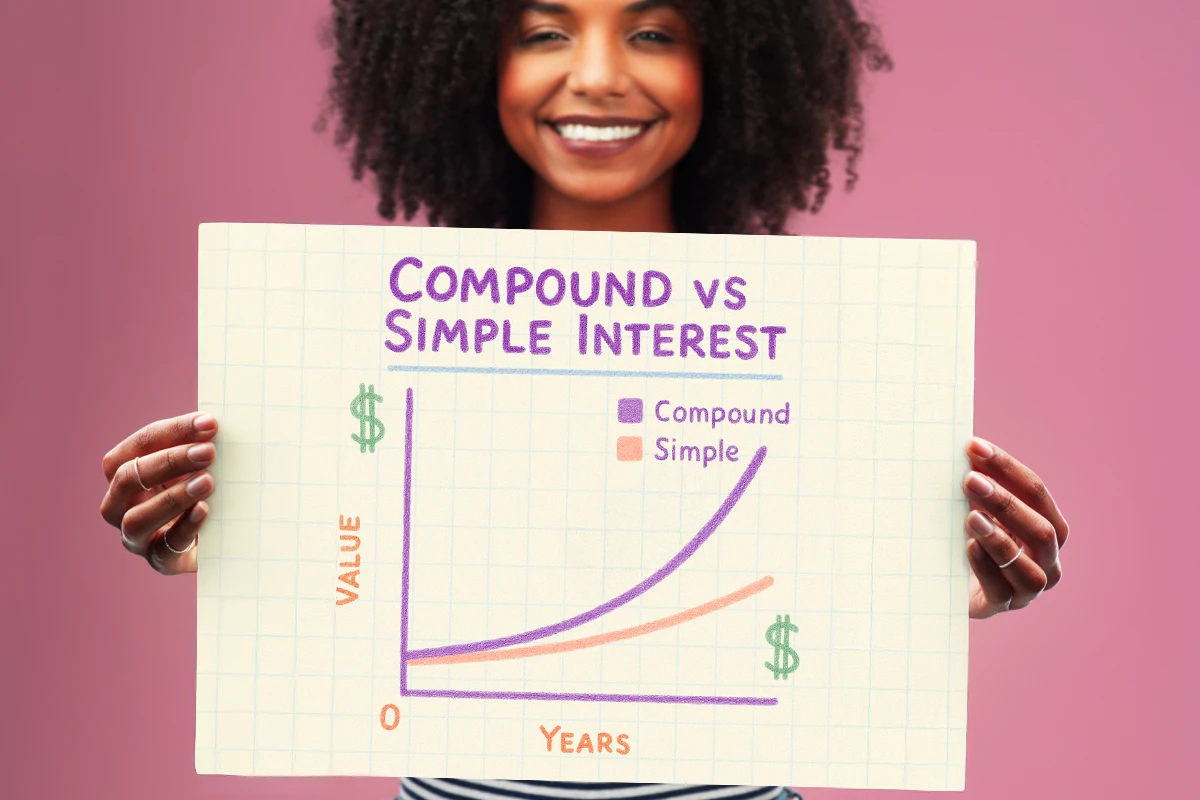
Law 15 — Understand the Power of Compound Interest
Compound interest is the key to long-term wealth. Start early, stay consistent, and let your money grow exponentially with time on your side.

The Beginner’s Guide to Getting Started with Compound Interest
Unlock the power of compound interest! This beginner's guide shows you how to grow your money faster with simple, smart strategies anyone can use.
The Dark Side of Compound Interest That Nobody Talks About
The Dark Side of Compound Interest reveals how debt can quietly grow and destroy your finances if left unchecked. Learn how to stop it before it snowballs.
A Beginner’s Guide to Passive Income Stream Ideas
Earn money while you sleep! Discover beginner-friendly passive income ideas—from digital products to real estate—that can bring in $500+ per month with ease.
For additional reference, see Investor.gov's compound interest resources (U.S. Securities and Exchange Commission).