
Learning how to talk to family about an estate plan helps you turn legal documents into instructions your loved ones can actually follow. The goal is not to debate every dollar; it is to explain who is responsible for what, where key information lives, why major choices were made, and when the plan should be revisited.
This conversation can prevent confusion during grief, illness, or a family emergency. It can also reveal practical gaps: an executor who does not know they were named, a medical agent who has never heard your care preferences, or family members who expect an equal inheritance when your documents say something different.
What your family needs to understand about your estate plan
Your family does not need to memorize your full estate plan. They do need enough information to avoid scrambling later. At a minimum, the conversation should answer five questions:
- Who is in charge? Name the executor, trustee, financial power of attorney, and health care decision-maker if those roles exist in your plan.
- Where are the documents? Explain where signed originals or accessible copies are stored and who can access them.
- What are the big decisions? Summarize the main distribution choices, guardianship wishes, care preferences, and unusual instructions.
- Why did you make those choices? Give enough rationale to reduce speculation, especially if gifts are unequal or roles are not assigned by birth order.
- What should happen next? Tell people whether they need to confirm a role, gather information, meet an advisor, or simply know where to look later.
A will, trust, beneficiary designation, power of attorney, and advance health care directive each do different jobs, and the names vary by jurisdiction. If your family is unclear on the basics, start with what an estate plan is designed to do. The U.S. National Institute on Aging also explains advance directives for health care and the decisions they can document.
A person named to make financial decisions should understand both the authority and its limits. Review how a durable power of attorney works before briefing that person.
Action: Write a one-page “family briefing” with roles, document locations, professionals to contact, and the three decisions most likely to surprise someone.

Decide how much detail to share before you invite everyone
Full transparency can reduce suspicion, but it can also create pressure, entitlement, or privacy concerns. Too little information protects privacy but may leave the people responsible for carrying out the plan unprepared.
- Always share role assignments with the people named. An executor, trustee, agent under power of attorney, or health care proxy should know they have been chosen and be willing to serve.
- Usually share document locations and access instructions. A document is not useful if no one can find it or access the attorney file, safe, password manager, or records system. Use a secure process for organizing important documents for heirs.
- Share the reasons for unequal treatment. If one child receives more, someone is excluded, or a caregiver receives compensation, silence can invite assumptions.
- Limit dollar details when disclosure could create harm. If someone is financially dependent, vulnerable to coercion, in active conflict, or likely to spend based on a future inheritance, focus on roles and principles rather than exact amounts.
- Use a professional meeting when the plan is complex. A neutral attorney, fiduciary, mediator, financial planner, or tax professional can explain structure without turning the meeting into a negotiation.
A useful middle ground is to share categories instead of balances: “retirement accounts have named beneficiaries,” “the house passes through the trust,” or “life insurance is intended to provide liquidity for final expenses.” Save precise balances for your fiduciaries or secure records unless they are necessary for understanding.
The U.S. Consumer Financial Protection Bureau publishes guides for people managing someone else’s money, which can help a prospective financial fiduciary understand the practical responsibility.
Action: Sort information into three columns: “everyone can know,” “only named decision-makers need to know,” and “keep private unless circumstances change.”
Prepare for the estate planning conversation in five steps

Confirm that your documents match your current wishes
Review your will, trust, beneficiary designations, powers of attorney, health care directives, guardianship nominations, and any letter of instruction. Marriage, divorce, birth, death, relocation, disability, business changes, and estrangement can make an old plan misleading. Use a structured estate plan review process before discussing the documents.
Create a short asset and contact inventory
List major accounts, insurance policies, real estate, debts, business interests, digital assets, safe deposit boxes, professional contacts, and recurring bills. A current net worth statement can help organize what exists without turning the family meeting into an accounting session.
Choose the right audience
You do not have to invite every relative to the same meeting. A spouse or partner, adult children, named fiduciaries, guardians, and likely caregivers may need different information. High-conflict relatives, minor children, or people unaffected by the plan may not belong in the first conversation.
Set the agenda in writing
Send a short note such as: “I want to explain who is named in my estate documents, where the documents are kept, and the values behind a few decisions. I am not asking anyone to agree with every choice, but I want the people affected to understand the plan.”
Decide what you will not debate
A family conversation is not a vote. Be clear about which choices are final, which are open to practical feedback, and which require a follow-up with your attorney.
Action: Before scheduling the meeting, update your document list, confirm named roles, and write a one-paragraph purpose statement.
How to structure the family meeting without creating a fight

The conversation should feel like a practical briefing, not a courtroom or surprise announcement.
- Open with the purpose. “I am sharing this so no one has to guess during a crisis.”
- Name the roles. Explain who is executor, trustee, power of attorney, health care agent, and backup decision-maker. If you are still deciding, review how to choose the right executor.
- Explain the documents at a high level. Identify what exists and where it is stored. Do not distribute unsigned drafts or incomplete instructions.
- Discuss sensitive choices. Address unequal gifts, guardianship, charitable giving, care preferences, memorial wishes, and business succession if relevant.
- Invite clarifying questions. Ask, “What would be unclear if you had to act tomorrow?”
- Separate feedback from decision-making. Say, “I will consider that with my attorney,” instead of deciding under pressure.
- End with next actions. Confirm who needs copies, contact details, or a follow-up meeting.
Avoid blaming language such as “I had to do this because you are irresponsible.” Use factual explanations: “I chose one trustee because the role requires detailed recordkeeping and quick communication.”
If someone becomes angry, acknowledge the emotion without arguing: “I hear that this feels unfair. I am not asking you to like the decision today. I want you to understand what the documents say and why I made the choice.”
Action: Write three sentences in advance: your opening purpose, your explanation for the most sensitive decision, and your boundary if the discussion becomes argumentative.
Worked scenario: explaining an unequal estate plan
Consider this example, which is illustrative rather than a recommendation:
- Maria is widowed and has three adult children: Alex, Ben, and Carla.
- Alex lives nearby and has provided unpaid caregiving; Ben and Carla live out of state.
- Maria wants Alex to receive a modestly larger share and organized Carla to serve as successor trustee.
- She wants to explain the difference without sharing exact account balances.
Saying “Everything is handled” would not explain who is in charge or why the gifts differ. Handing out current balances and inviting a vote could turn the meeting into a negotiation. Maria instead gives this briefing:
- Roles: “Carla is successor trustee because the job requires paperwork, deadlines, and coordination. Alex is my health care agent because he is nearby. Ben is the backup.”
- Distribution principle: “The plan recognizes Alex’s caregiving with an additional gift. The rest is divided according to the trust terms.”
- Asset map: “The house and taxable account are in the trust. Retirement accounts have beneficiary designations. The checking account is for expenses and final bills.”
- Access: “The signed documents are with my attorney and in my home file. Carla knows where the file is.”
- Boundary: “I will listen to practical concerns, but I am not asking you to vote.”
Maria then meets separately with Carla about trustee duties and with Alex about her care preferences. She gives Ben enough information to understand his backup role. The tradeoff is some lost privacy, but the explanation reduces the risk that her children later misunderstand why Alex received more or Carla was chosen as trustee.
Action: If your plan includes unequal gifts or role assignments, write the reason in plain language and decide whether it belongs in the meeting, a letter of instruction, or a private attorney file.
Common mistakes when discussing an estate plan
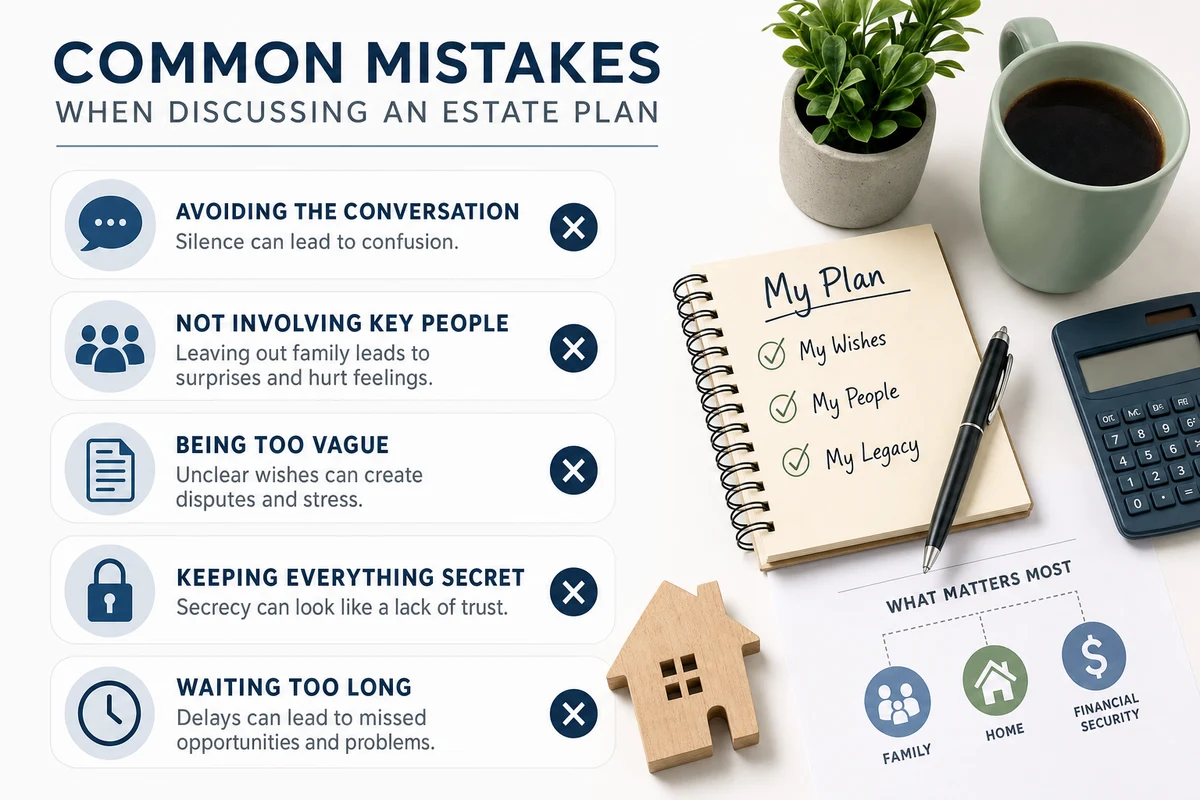
- Waiting until a crisis. Discuss roles while you can answer questions calmly.
- Assuming “oldest child” means “best executor.” Choose fiduciaries based on judgment, availability, organization, communication, and trustworthiness—not family rank.
- Hiding unequal decisions without a reason. You need not justify every choice, but silence can create suspicion when the documents are read.
- Sharing passwords casually. Digital access rules vary, and password sharing can create legal, security, or privacy problems. Use a secure process for passing passwords and digital accounts to beneficiaries.
- Rewriting the plan verbally. Take notes, then update legal documents properly. Verbal promises can create more confusion than clarity.
- Forgetting beneficiary designations. Retirement accounts, life insurance, and some payable-on-death accounts may pass according to beneficiary forms rather than a will. For U.S. retirement plans, review the IRS guidance on retirement-plan beneficiaries.
Action: After the meeting, send a short follow-up covering roles, document locations, professional contacts, and agreed next steps.
When to bring in an attorney, fiduciary, tax professional, or mediator
A family meeting cannot fix defective documents or replace personalized advice. Professional help is especially appropriate when:
- you have a blended family, former spouse, estranged heir, or dependent relative;
- you own a business, farm, rental property, or real estate in more than one jurisdiction;
- you want to disinherit someone or make highly unequal gifts;
- a beneficiary receives disability benefits or may need long-term support;
- you are planning for incapacity, dementia, or contested decision-making;
- your estate may have tax filing or liquidity issues under applicable rules;
- you expect someone to challenge the plan or pressure you to change it.
An estate planning attorney drafts and interprets legal documents. A tax professional can explain consequences under current rules. A financial planner can help coordinate assets, beneficiaries, and liquidity but should not give legal advice unless separately qualified. When choosing a financial planner, verify their credentials, services, fees, conflicts, and fiduciary obligations. A mediator can help families discuss conflict but does not replace independent legal counsel.
U.S. federal estate-tax rules and filing thresholds can change, so verify current requirements through the IRS estate-tax guidance and a qualified professional where needed.
Action: If any of these risk factors apply, schedule the professional appointment before the family meeting or invite the professional to a limited follow-up after the documents are finalized.
Prioritized next-step plan

- Review your documents. Confirm names, roles, backups, asset ownership, and beneficiary designations. Update anything inaccurate before explaining it.
- Prepare a one-page briefing. Include document locations, fiduciaries, professional contacts, major asset categories, and the decisions your family should understand.
- Talk privately with people who have legal responsibilities. Executors, trustees, agents, and guardians should understand the role and agree to serve.
- Hold the broader conversation. Focus on purpose, roles, document locations, sensitive decisions, questions, and next steps.
- Document the follow-up. Send practical reminders, update your letter of instruction, and store records where the right people can find them.
- Set a review trigger. Revisit the plan after major life events, relocation, relevant legal changes, or a meaningful change in assets, health, relationships, or fiduciaries.
Start with the people who must carry out your wishes, give them clear instructions, and use the broader family conversation to reduce surprises—not to surrender control of your plan.