
Cognitive biases in finance are predictable thinking errors that can make you buy too aggressively, sell too quickly, hold losers too long, or ignore risk when you most need a plan. By the end of this guide, you will know how to spot the most common money biases, test a decision with simple math, and install practical guardrails before emotion takes over.
The goal is not to become a robot. It is to recognize when your instincts are helpful, when they are distorting the facts, and what rule you will follow before the next market headline, bonus, job change, or portfolio drop pressures you to act.
What cognitive biases in finance change about your decisions
A cognitive bias is a systematic shortcut in thinking. Shortcuts are useful when you need to make fast everyday choices, but they can be expensive when the decision involves compounding, taxes, debt, insurance, or long time horizons. In personal finance, the danger is not that you make one bad call. The danger is that the same mental pattern repeats for years.
For example, you may know that diversification matters, yet still hold too much of one stock because you feel unusually informed. You may understand that retirement investing is long term, yet sell during a downturn because the pain of seeing a lower balance feels immediate. You may promise to save more next month, yet spend the raise because the present reward is visible and the future benefit is abstract.
A useful way to think about money biases is this: they usually do not announce themselves as bias. They feel like common sense in the moment. That is why the antidote is not more willpower; it is a repeatable decision process.
Action: Before changing an investment, taking on debt, or delaying a savings goal, name the decision in one sentence: “I am deciding whether to ______ because ______.” If the reason is mostly emotional, slow down.
Overconfidence bias: when conviction becomes concentration risk

Overconfidence bias leads people to overestimate their knowledge, underestimate risk, and assume favorable outcomes are more likely than they really are. In finance, it often shows up as frequent trading, under-diversification, or the belief that you can consistently identify winners before other investors do.
The practical issue is not confidence itself. Confidence helps you start investing, negotiate pay, or make a plan. The problem begins when confidence removes the need for evidence. A concentrated position may be appropriate for a founder, an employee with restricted stock, or a business owner, but it should be a conscious risk—not an accident created by a good story.
To test overconfidence, ask three questions before increasing a position:
- What would prove me wrong? If nothing would, you may be defending an identity instead of evaluating an investment.
- How much could I lose without changing my life? A good idea can still be too large for your plan.
- Am I being paid enough for this extra risk? Concentration should have a clear purpose beyond excitement.
Diversification is the main guardrail. Spreading money across asset classes, sectors, and account types limits the damage from being wrong about one company, theme, or timing decision. For a deeper process, see our guide to building a diversified wealth strategy.
Action: Set a maximum percentage for any single stock, fund, employer equity grant, or speculative asset. If you are above it, create a written plan to reduce the position over time instead of deciding under pressure.
Loss aversion: why losses feel bigger than gains

Loss aversion describes the tendency to feel the pain of a loss more intensely than the pleasure of an equal gain. In practice, it can cause investors to hold losing positions too long because selling would make the loss feel “real,” while selling winners too early to protect a small gain.
Loss aversion also affects cash decisions. Someone may keep too much money in cash after a market drop because avoiding another decline feels safer than pursuing the long-term return they originally planned for. That may be reasonable for emergency savings, a home down payment, or money needed soon. It becomes a problem when long-term money is treated like short-term money because a recent loss still hurts.
The cleanest defense is to separate money by time horizon:
- Near-term spending: cash or low-volatility accounts for bills, emergency funds, and planned purchases.
- Medium-term goals: a more conservative mix if the money is needed within a few years.
- Long-term investing: a diversified portfolio designed to tolerate volatility.
When each dollar has a job, a market drop is easier to interpret. You are not asking, “How do I stop this pain?” You are asking, “Has the purpose or timeline for this money changed?”
Action: Write a sell rule before you need one. Examples: “I sell if this investment no longer fits my allocation,” “I sell if the original thesis is broken,” or “I rebalance twice a year regardless of headlines.”
Confirmation bias, anchoring, herd behavior, and present bias
Some money biases are less dramatic than panic selling but just as persistent. They quietly shape what information you notice, which numbers you care about, and whose behavior you copy.
Confirmation bias is the tendency to favor information that supports what you already believe while discounting evidence that challenges it. If you own a stock, you may read only bullish commentary and dismiss legitimate warnings as negativity. The antidote is to assign someone or something the role of opposition: a bear case, a checklist, a written pre-mortem, or a trusted person who is allowed to challenge your thinking.
Anchoring bias happens when you fixate on a reference point that may no longer be relevant. The most common anchor is your purchase price. If a stock fell from $80 to $45, the $80 price can feel like the “true” value even if the business outlook has changed. A better question is: “If I had cash today, would I buy this at $45 instead of my next-best option?”
Herd mentality is the urge to follow the crowd because it feels safer than standing apart. It can appear as fear of missing out when an asset is rising or panic when everyone seems to be selling. The crowd may sometimes be right, but “everyone is doing it” is not an investment thesis.
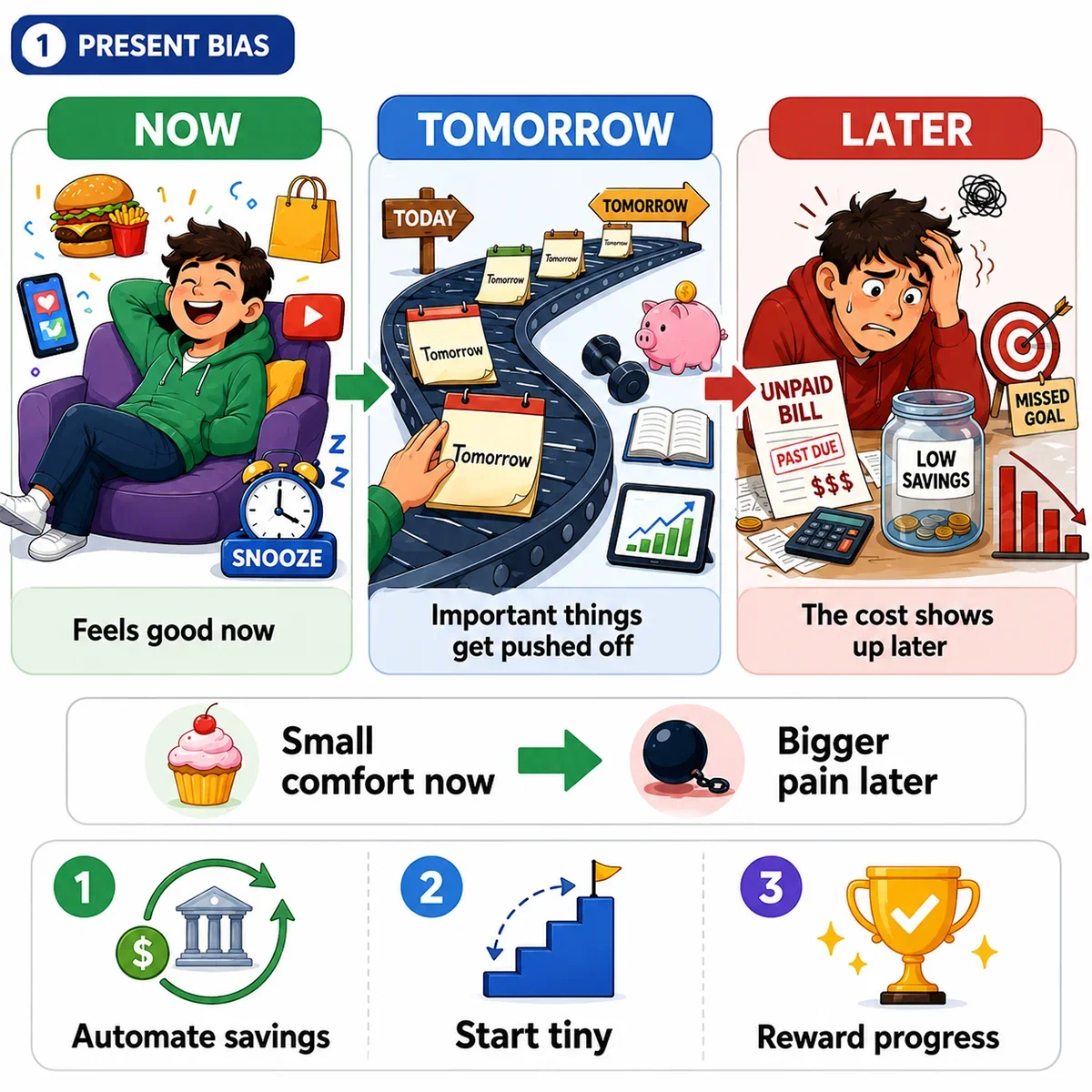
Present bias is the tendency to overvalue rewards available now and undervalue future benefits. It is why saving for retirement can feel less urgent than a purchase today, even when the future goal matters more. Automation helps because it moves the decision away from the moment of temptation. For more on this habit, read how delayed gratification builds wealth.
Action: For your next major money decision, write a one-paragraph “opposite case.” Include why a reasonable person would not do what you are considering. If you cannot write it, you are not ready to decide.
A worked scenario: using bias checks before investing a bonus
Consider Maya, who receives a $12,000 after-tax bonus. She has a six-month emergency fund, no high-interest debt, and already contributes to a retirement account. She is considering putting $8,000 into a single popular stock because coworkers are excited about it, then using the remaining $4,000 for a vacation.
There is nothing automatically wrong with enjoying part of a bonus or investing in an individual stock. The problem is that several biases may be working at once:
- Herd behavior: coworkers are talking about the same stock.
- Overconfidence: Maya feels she understands the opportunity after reading only positive commentary.
- Present bias: the vacation feels more real than adding to long-term investments.
- Confirmation bias: she has not looked for the strongest argument against the stock.
She decides to slow the decision down and compare choices. First, she sets a rule: no more than 5% of her investable portfolio can be in any single stock. Because $8,000 would put her above that limit, she caps the stock purchase at $3,000. Second, she decides on a values-based split: $3,000 for the stock, $5,000 into her diversified long-term portfolio, $2,500 for the vacation, and $1,500 held for upcoming car repairs.
Now she pressure-tests the stock purchase with expected value. These probabilities are not research; they are simply Maya’s assumptions for thinking clearly.
Expected value means multiplying each possible outcome by its probability, then adding the results. If Maya invests $3,000, she sketches three one-year outcomes: a 25% chance of gaining $1,200, a 40% chance of gaining $150, and a 35% chance of losing $900.
The calculation is: ($1,200 × 0.25) + ($150 × 0.40) + (-$900 × 0.35) = $300 + $60 - $315 = $45. This does not mean she will earn $45. It means that under her own assumptions, the opportunity is not obviously attractive enough to justify an oversized bet. The math helps her see that excitement was doing more work than analysis.
Action: When a choice feels compelling, run a simple scenario table. If the decision only looks good under the most optimistic case, reduce the size, gather better information, or walk away.
Specific implementation steps for bias-resistant decisions
You do not need a complicated system. You need a short process that you will actually use when your emotions are loud. The following sequence works for investments, major purchases, debt payoff decisions, and savings tradeoffs.
Create a one-page financial policy
Write your target emergency fund, contribution rate, investment allocation, rebalancing schedule, and maximum single-position size. A simple policy prevents every market move from becoming a fresh debate.
Define your “cooling-off” threshold
Choose which decisions require a pause. For example: any investment trade over $1,000, any purchase over $500, any loan, or any change to retirement contributions. Use thresholds that fit your situation.
Use automation where the choice is already settled
If you know you want to save or invest monthly, automate it. Automation is especially useful against present bias because the money moves before you renegotiate with yourself.
Keep a decision journal
Before acting, write the date, decision, reason, expected outcome, biggest risk, and what would make you reverse course. Review it quarterly. The point is not to shame yourself; it is to compare your confidence with reality.
Pre-commit to review dates
Decide when you will review your plan: monthly for cash flow, quarterly for goals, and once or twice a year for portfolio allocation. Reviewing too often can feed anxiety; reviewing too rarely can let drift go unnoticed.
Action: Put one recurring calendar event on your schedule today: “Money decision review.” Attach your policy and decision journal so the system is easy to follow.
Tradeoffs and common failure modes
Bias guardrails are powerful, but they are not free. A strict rule can prevent a bad impulse, but it can also slow a legitimate opportunity. Automation can build consistency, but it can become stale if your income, expenses, or goals change. A diversified portfolio can reduce concentration risk, but it also means you will not capture the full upside of a single winner.
The point is to choose tradeoffs intentionally. For most households, avoiding catastrophic mistakes is more important than maximizing every possible gain. Still, your rules should leave room for new information. If your job changes, your tax situation changes, you receive equity compensation, or you are nearing a major purchase, your old rules may need to be updated. When decisions involve tax, legal, insurance, or individualized investment advice, consider a qualified professional who can review your specific facts.
Common failure modes include:
- Vague rules: “Be careful” is not a rule. “No single stock above 5% without a written review” is a rule.
- Selective evidence: reading more articles is not research if they all agree with you.
- Moving the goalposts: changing your sell rule after a position drops is usually loss aversion wearing a disguise.
- Over-checking: looking at long-term investments daily can turn normal volatility into an emotional emergency.
- Ignoring account type: selling in a taxable account may have tax consequences, while changes inside tax-advantaged accounts may work differently depending on jurisdiction and current rules.
If money stress is making it hard to think clearly, the issue may be emotional as well as analytical. Our guide to the psychology of money and overcoming financial anxiety can help you separate financial facts from fear-driven narratives. You can also compare your habits with common investing mistakes that can cost you money.
Action: Identify your most likely failure mode from the list above and write one countermeasure. Make it concrete enough that someone else could tell whether you followed it.
Bias-busting checklist
- Write down your reasoning before any major financial decision
- Diversify so no single mistake can sink your plan
- Set written goals with a time horizon for each pool of money
- Automate contributions when the decision is already settled
- Create a maximum size for single stocks, speculative assets, or employer equity
- Pressure-test your thinking before acting
- ∼ Seek the strongest opposing argument
- ∼ Ask whether you would buy it today if you did not already own it
- ∼ Check whether you are following the crowd
- Compare options with scenarios or expected value when the stakes are meaningful
- Review past decisions against your original expectations
Prioritized next action

Do not try to fix every bias at once. Start with the bias most likely to cost you money in the next 90 days. If you trade frequently, address overconfidence. If you are afraid to invest long-term money, address loss aversion. If you keep delaying saving, address present bias. If you only read views that agree with you, address confirmation bias.
Your highest-value next action is to create a one-page financial policy before your next decision point. Include your target allocation, contribution plan, rebalancing schedule, single-position limit, and cooling-off threshold. Then set one calendar reminder to review it. A simple rule written when you are calm is more useful than a brilliant insight discovered after you have already reacted.