
Choosing a financial planner is a decision about process, fit, cost, and accountability—not just credentials or a friendly first meeting. This guide will help you decide whether you need a planner, compare fee models, ask better interview questions, and choose someone who can coordinate investing, retirement, tax-aware planning, insurance, and estate planning without overpromising results.
The right financial planner should clarify what to do first, which tradeoffs matter, and when an estate attorney, tax professional, or insurance agent should be involved. Before hiring one, identify your highest-impact priorities using an approach such as the 80/20 personal finance framework.
What a financial planner should do—and what they should not promise
A financial planner helps organize decisions across retirement, cash flow, investments, taxes, insurance, employee benefits, education funding, charitable giving, and estate planning. The exact scope depends on the engagement.
A planner is different from someone who only sells a financial product. Some professionals do both, which is not automatically bad, but you need to understand what advice you are buying, how the planner is paid, and what conflicts may exist.
A planner should not guarantee investment returns, eliminate all tax, make legal promises, or imply that a plan removes risk. Markets, laws, family circumstances, and planning assumptions can change. Good planning improves decision quality; it does not make uncertainty disappear.
Action: write down your top three decisions before contacting planners. Examples include “Can I retire in five years?”, “Should I pay down the mortgage or invest?”, and “Am I taking too much risk?”
When it makes sense to hire a financial planner
You may benefit from a planner when a decision has multiple moving parts and a mistake would be expensive or hard to reverse. Common triggers include approaching retirement, receiving an inheritance, selling a business, combining finances, managing equity compensation, supporting aging parents, navigating divorce, or building an estate plan. Business owners may need the additional succession and liquidity coordination covered in estate planning for business owners.
Estate planning prepares for how assets, responsibilities, and decisions are handled if you die or become incapacitated. It can involve beneficiary designations, wills, trusts, powers of attorney, health care directives, account titling, guardianship decisions, and liquidity planning. Requirements depend on your jurisdiction and can change over time, so periodically review and update your estate plan.

A planner can identify whether retirement accounts name the intended beneficiaries, insurance supports dependents, cash reserves could cover final expenses, and account titles match your goals. They can also flag the need for a durable power of attorney, but a planner who is not a licensed attorney generally should not draft legal documents or give legal advice.
Use an estate attorney licensed in your jurisdiction for legal documents, a qualified tax professional for complex tax projections or compliance, and an insurance professional for policy placement and underwriting. An independent review can also help you identify which types of insurance make sense before buying coverage.
Action: decide whether your primary need is planning, product selection, legal drafting, tax compliance, or investment management. That answer determines which professional should lead.
How to compare financial planner credentials, fiduciary duty, and specialization

Credentials can help you screen planners, but no credential replaces due diligence. Verify each credential with its issuing organization and check disciplinary history through the appropriate regulator or professional body. In the United States, start with the SEC's free investment professional background check and review both the individual and the firm.
Ask whether the planner acts as a fiduciary when providing advice. A fiduciary is expected to put the client’s interests ahead of their own within the engagement’s scope. The legal meaning can vary by jurisdiction, license, and service model, so request a written answer explaining whether the duty applies at all times or only to certain services.
Specialization also matters. A planner who works mainly with young families may not be the best fit for business succession, retirement withdrawals, or cross-border tax issues. Look for repeated experience with situations similar to yours, not just years in the industry.
| What to evaluate | Helpful question | What a strong answer sounds like |
|---|---|---|
| Scope | What is included in the written plan? | Specific deliverables, timeline, and topics. |
| Fiduciary status | Will you act as a fiduciary? | A written explanation of when the obligation applies. |
| Compensation | How are you paid? | Transparent fees, commissions, referrals, and conflicts. |
| Experience | How often do you work with clients like me? | Relevant examples without revealing private information. |
| Implementation | Do you implement recommendations? | Clear boundaries among planning, management, products, and referrals. |
Action: shortlist a planner only after you can explain their credential, legal duty, compensation, specialty, and scope in one paragraph.
Financial planner fee models: what you pay for and what to watch
Cost includes the invoice, product expenses, investment management fees, commissions, taxes, and the opportunity cost of generic advice. The U.S. Department of Labor’s guide to retirement plan fees and expenses explains how even fees that appear small can affect long-term retirement savings.
- Flat fee: a set amount for a plan, project, or annual engagement. This can suit defined planning work without tying cost to portfolio size.
- Hourly fee: payment for time, which can be efficient for focused questions you can implement yourself.
- Assets under management fee: a charge based on managed assets. It may include ongoing oversight, but cost rises with portfolio size.
- Commission: compensation when you buy a product, creating an incentive that must be disclosed and evaluated.
- Hybrid model: a combination of fees and commissions requiring clarity about when each form of compensation applies.
Request a written fee schedule and a plain-English estimate of first-year costs. For investments or insurance, ask about internal expenses, surrender charges, lockups, tax consequences, and termination costs.
Action: ask the planner to complete this sentence: “Over the next 12 months, I will pay you directly through ___ and indirectly through ___.”
A seven-step process for choosing a financial planner

Define the decision you need to make
Start with decisions, not products. “I need help with retirement income” is more useful than “I need an annuity.” This prevents a solution from being sold before the problem is diagnosed.
Gather your financial documents
Prepare account statements, policies, debt balances, relevant tax returns, benefit summaries, estate documents, and a spending estimate. A system for organizing important financial documents can make this meeting and future emergencies easier.
Create a shortlist from credible channels
Use credential directories, professional associations, and referrals from attorneys or tax professionals. If the person acts as a broker, confirm registrations and disclosures in FINRA BrokerCheck.
Screen for fit before the sales meeting
Ask for services, fees, minimums, client profile, fiduciary status, and conflicts before sharing detailed personal information.
Interview at least two planners
Ask each planner how they would approach your main decision, what information they need, and when they would involve another professional.
Review the engagement agreement slowly
Confirm services, fees, responsibilities, conflicts, termination terms, privacy practices, and whether investment discretion is granted. Request written clarification before signing.
Set review dates and success measures
Progress might mean a completed estate review, retirement withdrawal strategy, simplified accounts, or documented investment policy—not merely short-term portfolio returns.
Action: pause if a planner pushes a product, transfer, or long-term commitment before understanding your facts.
Questions, warning signs, and tradeoffs to evaluate
Bring the same questions to each interview so you can compare answers fairly.
- What problems do you often solve for clients like me?
- What is outside your scope?
- How do you build and document recommendations?
- How are you compensated, including referrals and product expenses?
- Will you put your fiduciary commitment and conflicts in writing?
- How do you handle market declines?
- How will we measure success after one year?
Warning signs include guaranteed returns, pressure to move assets quickly, undisclosed fees, dismissive answers, overemphasis on one product, or advice that ignores tax, legal, family, and cash-flow context.
Every model has tradeoffs. Flat-fee planning may require more work from you. Ongoing management can provide accountability but cost more over time. Commission-based advice can reduce upfront cost while introducing product incentives. Specialized planners may solve one issue well but provide less general coaching.
Action: score each planner on clarity, relevant experience, cost transparency, conflicts, communication, and implementation. Name the tradeoff you accept before signing.
Worked scenario: comparing two planner options
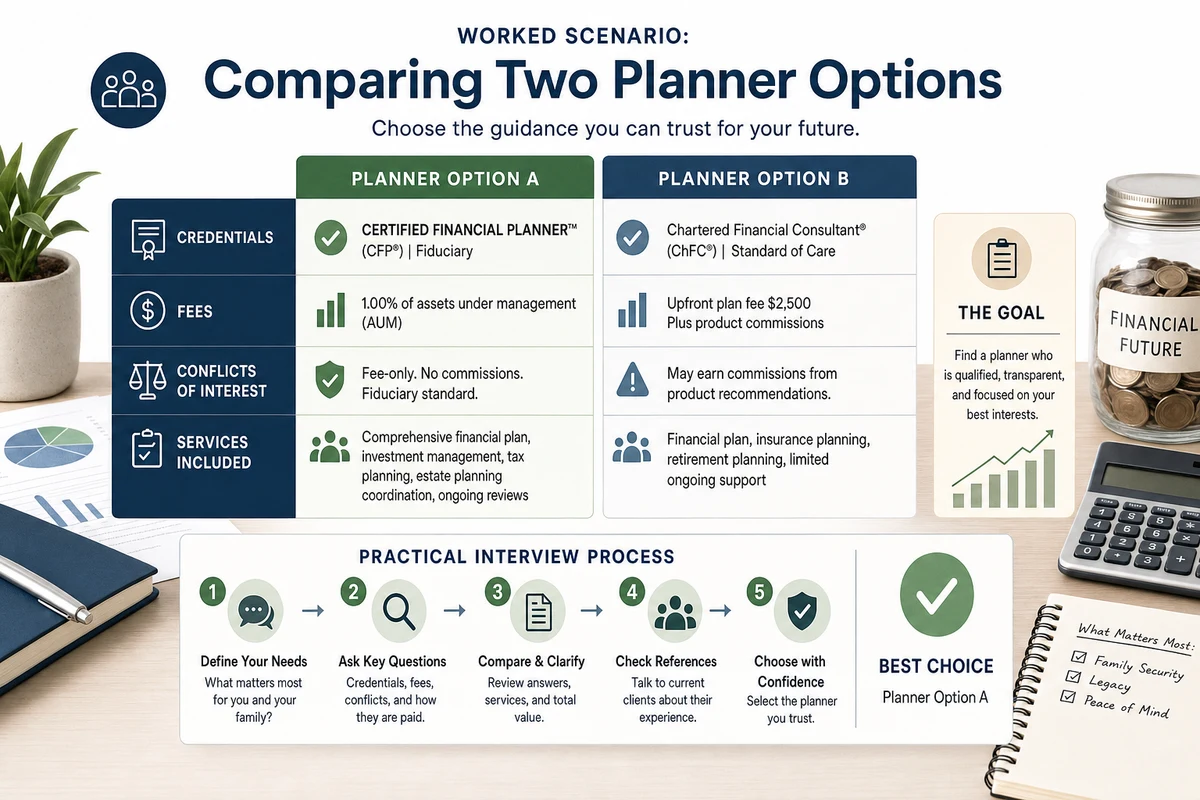
Maya and Jordan are married, in their early 50s, and want to retire around age 62. They have two adult children, an older will, several retirement accounts, a brokerage account, a mortgage, and term life insurance. They want a retirement plan, estate coordination, and an investment policy—not a stock picker. They also review whether their life insurance still provides the intended safety net.
They want a written retirement projection, a beneficiary review, at least two meetings in six months, and documented reasons before buying any product.
| Comparison point | Planner A | Planner B |
|---|---|---|
| Fee model | Flat project fee | Ongoing fee based on managed assets |
| Primary service | Planning and an implementation checklist | Investment management plus planning meetings |
| Estate role | Reviews beneficiaries and refers legal work | Reviews beneficiaries and manages transferred accounts |
| Best fit | They can implement with guidance | They want ongoing delegation |
| Main tradeoff | More follow-through falls on them | Fees continue as long as management continues |
They use this practical framework: Expected value of hiring = avoided mistakes + better decisions + saved time − total cost − added complexity. It is not a scientific equation. Its purpose is to compare the value of coordination and implementation with the full cost.
Planner A fits if they can implement tasks and want a defined project. Planner B fits if they prefer delegation and accept a continuing fee. If neither explains assumptions clearly, they keep interviewing. They also confirm who will handle fiduciary roles such as choosing the right executor rather than assuming the planner fills every role.
Action: compare planners against your own assumptions. A complex retiree, new investor, grieving spouse, and busy business owner may each need a different level of support.
Prioritized next-step plan for choosing a financial planner
- List your top three decisions. Examples include retirement timing, beneficiaries, debt payoff, investment risk, insurance, taxes, or estate documents.
- Choose the appropriate lead professional. Use a planner for integrated planning, an attorney for legal documents, and a tax professional for complex tax advice.
- Gather your documents. Include statements, debts, policies, benefits, relevant tax records, and estate documents. The Department of Labor’s guide to understanding your retirement plan can help U.S. employees identify plan information to review.
- Shortlist two to four planners. Verify credentials, disciplinary records, specialization, and service minimums.
- Ask identical interview questions. Compare scope, fees, fiduciary status, conflicts, implementation, and communication.
- Review the agreement before transferring assets. Confirm fees, services, termination terms, discretion, and conflicts in writing.
- Set a 90-day target. Examples include updating beneficiaries, meeting an estate attorney, documenting an investment policy, or completing a retirement projection.
Your immediate next step is to write a one-page planning brief with your top decisions, household facts, accounts, constraints, and desired outcome. Use it to choose a financial planner based on fit, scope, and accountability rather than presentation alone.